| dc.contributor | Vall d'Hebron Barcelona Hospital Campus |
| dc.contributor.author | Doležil, David |
| dc.contributor.author | Paemeleire, Koen |
| dc.contributor.author | Stepien, Adam |
| dc.contributor.author | Stude, Philipp |
| dc.contributor.author | Snellman, Josefin |
| dc.contributor.author | Pozo-Rosich, Patricia |
| dc.date.accessioned | 2024-05-21T09:35:39Z |
| dc.date.available | 2024-05-21T09:35:39Z |
| dc.date.issued | 2024-05-01 |
| dc.identifier.citation | Pozo-Rosich P, Dolezil D, Paemeleire K, Stepien A, Stude P, Snellman J, et al. Early Use of Erenumab vs Nonspecific Oral Migraine Preventives: The APPRAISE Randomized Clinical Trial. JAMA Neurol. 2024 May 1;81(5):461–70. |
| dc.identifier.issn | 2168-6157 |
| dc.identifier.uri | https://hdl.handle.net/11351/11479 |
| dc.description | Erenumab; Oral preventives; Migraine |
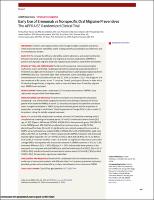
| dc.description.abstract | Importance Patients with migraine often cycle through multiple nonspecific preventive medications due to poor tolerability and/or inadequate efficacy leading to low adherence and increased disease burden.
Objective To compare the efficacy, tolerability, patient adherence, and patient satisfaction between erenumab and nonspecific oral migraine preventive medications (OMPMs) in patients with episodic migraine (EM) who had previously failed 1 or 2 preventive treatments.
Design, Setting, and Participants The 12-month prospective, interventional, global, multicenter, active-controlled, randomized clinical trial comparing sustained benefit of 2 treatment paradigms (erenumab qm vs oral prophylactics) in adult episodic migraine patients (APPRAISE) trial was a 12-month open-label, multicenter, active-controlled, phase 4 randomized clinical trial conducted from May 15, 2019, to October 1, 2021. This pragmatic trial was conducted at 84 centers across 17 countries. Overall, participants 18 years or older with a 12-month or longer history of migraine, and 4 or more but fewer than 15 monthly migraine days (MMDs) were included.
Interventions Patients were randomized (2:1) to receive erenumab or OMPMs. Dose adjustment was permitted (label dependent).
Main Outcomes and Measures The primary end point was the proportion of patients completing 1 year of the initially assigned treatment and achieving a reduction of 50% or greater from baseline in MMDs at month 12. Secondary end points included the cumulative mean change from baseline in MMDs during the treatment period and the proportion of responders according to the Patients’ Global Impression of Change (PGIC) scale at month 12 for patients taking the initially assigned treatment.
Results A total of 866 patients were screened, of whom 245 failed the screening and 621 completed the screening and baseline period. Of the 621 randomized patients (mean [SD] age, 41.3 [11.2] years; 545 female [87.8%]; 413 [66.5%] in the erenumab group; 208 [33.5%] in the OMPM group), 523 (84.2%) completed the treatment phase, and 98 (15.8%) discontinued the study. At month 12, significantly more patients assigned to erenumab vs OMPM achieved the primary end point (232 of 413 [56.2%] vs 35 of 208 [16.8%]; odds ratio [OR], 6.48; 95% CI, 4.28-9.82; P <.001). Compared with OMPMs, treatment with erenumab showed higher responder rate (314 of 413 [76.0%] vs 39 of 208 [18.8%]; OR, 13.75; 95% CI, 9.08-20.83; P <.001) on the PGIC scale (≥5 at month 12). Significant reduction in cumulative average MMDs was reported with erenumab treatment vs OMPM treatment (−4.32 vs −2.65; treatment difference [SE]: −1.67 [0.35] days; P < .001). Substantially fewer patients in the erenumab arm compared with the OMPM arm switched medication (9 of 413 [2.2%] vs 72 of 208 [34.6%]) and discontinued treatment due to adverse events (12 of 408 [2.9%] vs 48 of 206 [23.3%]). No new safety signals were identified.
Conclusions and Relevance Results of this randomized clinical trial demonstrated that earlier use of erenumab in patients with EM who failed 1 or 2 previous preventive treatments provided greater and sustained efficacy, safety, and adherence than continuous OMPM. |
| dc.language.iso | eng |
| dc.publisher | American Medical Association |
| dc.relation.ispartofseries | JAMA Neurology;81(5) |
| dc.rights | Attribution-NonCommercial-NoDerivatives 4.0 International |
| dc.rights.uri | http://creativecommons.org/licenses/by-nc-nd/4.0/ |
| dc.source | Scientia |
| dc.subject | Migranya - Tractament |
| dc.subject | Anticossos monoclonals - Ús terapèutic |
| dc.subject | Medicació oral |
| dc.subject.mesh | Migraine Disorders |
| dc.subject.mesh | /drug therapy |
| dc.subject.mesh | Antibodies, Monoclonal, Humanized |
| dc.subject.mesh | Administration, Oral |
| dc.title | Early Use of Erenumab vs Nonspecific Oral Migraine Preventives: The APPRAISE Randomized Clinical Trial |
| dc.type | info:eu-repo/semantics/article |
| dc.identifier.doi | 10.1001/jamaneurol.2024.0368 |
| dc.subject.decs | trastornos migrañosos |
| dc.subject.decs | /farmacoterapia |
| dc.subject.decs | anticuerpos monoclonales humanizados |
| dc.subject.decs | administración oral |
| dc.relation.publishversion | https://doi.org/10.1001/jamaneurol.2024.0368 |
| dc.type.version | info:eu-repo/semantics/publishedVersion |
| dc.audience | Professionals |
| dc.contributor.organismes | Institut Català de la Salut |
| dc.contributor.authoraffiliation | [Pozo-Rosich P] Grup de Recerca de Cefalea i Dolor Neurològic, Vall d’Hebron Institut de Recerca (VHIR), Barcelona, Spain. Departament de Medicina, Universitat Autònoma de Barcelona, Bellaterra, Spain. Unitat de Cefalees, Servei de Neurologia, Vall d’Hebron Hospital Universitari, Barcelona, Spain. [Dolezil D] Headache Center, Dado Medical sro, Prague, Czech Republic. [Paemeleire K] Department of Neurology, Ghent University Hospital, Ghent, Belgium. [Stepien A] Department of Neurology, Military Institute of Medicine-National Research Institute, Warsaw, Poland. [Stude P] Neurological Practice Dr Stude, Bochum, Germany. [Snellman J] Novartis Pharma AG, Basel, Switzerland |
| dc.identifier.pmid | 38526461 |
| dc.identifier.wos | 001195274500002 |
| dc.rights.accessrights | info:eu-repo/semantics/openAccess |

 Private area
 Contact Us