| dc.contributor | Vall d'Hebron Barcelona Hospital Campus |
| dc.contributor.author | Mayer, Isabella |
| dc.contributor.author | Doma, Eszter |
| dc.contributor.author | Klampfl, Thorsten |
| dc.contributor.author | Prchal-Murphy, Michaela |
| dc.contributor.author | Kollmann, Sebastian |
| dc.contributor.author | Schirripa, Alessia |
| dc.contributor.author | Malumbres, Marcos |
| dc.date.accessioned | 2024-07-18T08:13:44Z |
| dc.date.available | 2024-07-18T08:13:44Z |
| dc.date.issued | 2024-07-11 |
| dc.identifier.citation | Mayer IM, Doma E, Klampfl T, Prchal-Murphy M, Kollmann S, Schirripa A, et al. Kinase-inactivated CDK6 preserves the long-term functionality of adult hematopoietic stem cells. Blood. 2024 Jul 11;144(2):156–170. |
| dc.identifier.issn | 1528-0020 |
| dc.identifier.uri | https://hdl.handle.net/11351/11723 |
| dc.description | Inactivated CDK6; Hematopoietic stem cells |
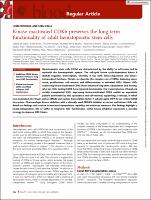
| dc.description.abstract | Hematopoietic stem cells (HSCs) are characterized by the ability to self-renew and to replenish the hematopoietic system. The cell-cycle kinase cyclin-dependent kinase 6 (CDK6) regulates transcription, whereby it has both kinase-dependent and kinase-independent functions. Herein, we describe the complex role of CDK6, balancing quiescence, proliferation, self-renewal, and differentiation in activated HSCs. Mouse HSCs expressing kinase-inactivated CDK6 show enhanced long-term repopulation and homing, whereas HSCs lacking CDK6 have impaired functionality. The transcriptomes of basal and serially transplanted HSCs expressing kinase-inactivated CDK6 exhibit an expression pattern dominated by HSC quiescence and self-renewal, supporting a concept, in which myc-associated zinc finger protein (MAZ) and nuclear transcription factor Y subunit alpha (NFY-A) are critical CDK6 interactors. Pharmacologic kinase inhibition with a clinically used CDK4/6 inhibitor in murine and human HSCs validated our findings and resulted in increased repopulation capability and enhanced stemness. Our findings highlight a kinase-independent role of CDK6 in long-term HSC functionality. CDK6 kinase inhibition represents a possible strategy to improve HSC fitness. |
| dc.language.iso | eng |
| dc.publisher | American Society of Hematology |
| dc.relation.ispartofseries | Blood;144(2) |
| dc.rights | Attribution-NonCommercial-NoDerivatives 4.0 International |
| dc.rights.uri | http://creativecommons.org/licenses/by-nc-nd/4.0/ |
| dc.source | Scientia |
| dc.subject | Rates (Animals de laboratori) |
| dc.subject | Cèl·lules mare hematopoètiques |
| dc.subject | Transcriptomes |
| dc.subject | Quinases dependents de ciclina |
| dc.subject.mesh | Cell Proliferation |
| dc.subject.mesh | Hematopoietic Stem Cells |
| dc.subject.mesh | Cyclin-Dependent Kinase 6 |
| dc.subject.mesh | Transcriptome |
| dc.subject.mesh | Mice |
| dc.title | Kinase-inactivated CDK6 preserves the long-term functionality of adult hematopoietic stem cells |
| dc.type | info:eu-repo/semantics/article |
| dc.identifier.doi | 10.1182/blood.2023021985 |
| dc.subject.decs | proliferación celular |
| dc.subject.decs | células madre hematopoyéticas |
| dc.subject.decs | cinasa 6 dependiente de la ciclina |
| dc.subject.decs | transcriptoma |
| dc.subject.decs | ratones |
| dc.relation.publishversion | https://doi.org/10.1182/blood.2023021985 |
| dc.type.version | info:eu-repo/semantics/publishedVersion |
| dc.audience | Professionals |
| dc.contributor.organismes | Institut Català de la Salut |
| dc.contributor.authoraffiliation | [Mayer IM, Doma E, Klampfl T, Prchal-Murphy M, Kollmann S, Schirripa A] University of Veterinary Medicine, Vienna, Vienna, Austria. [Malumbres M] Cancer Cell Cycle Group, Vall d’Hebron Institute of Oncology (VHIO), Barcelona, Spain. Cell Division and Cancer Group, Spanish National Cancer Research Center, Madrid, Spain. Institució Catalana de Recerca i Estudis Avançats, Barcelona, Spain |
| dc.identifier.pmid | 38684032 |
| dc.rights.accessrights | info:eu-repo/semantics/openAccess |

 Private area
 Contact Us