| dc.contributor | Vall d'Hebron Barcelona Hospital Campus |
| dc.contributor.author | Seed, George |
| dc.contributor.author | Beije, Nick |
| dc.contributor.author | Yuan, Wei |
| dc.contributor.author | Bertan, Claudia |
| dc.contributor.author | Goodall, Jane |
| dc.contributor.author | Lundberg, Arian |
| dc.contributor.author | Mateo, Joaquin |
| dc.date.accessioned | 2025-01-17T11:57:28Z |
| dc.date.available | 2025-01-17T11:57:28Z |
| dc.date.issued | 2024-12-09 |
| dc.identifier.citation | Seed G, Beije N, Yuan W, Bertan C, Goodall J, Lundberg A, et al. Elucidating acquired PARP inhibitor resistance in advanced prostate cancer. Cancer Cell. 2024 Dec 9;42(12):2113-2123.e4. |
| dc.identifier.issn | 2053-3624 |
| dc.identifier.uri | https://hdl.handle.net/11351/12431 |
| dc.description | DNA repair; Genomics; Prostate cancer |
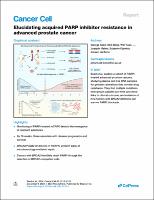
| dc.description.abstract | PARP inhibition (PARPi) has anti-tumor activity against castration-resistant prostate cancer (CRPC) with homologous recombination repair (HRR) defects. However, mechanisms underlying PARPi resistance are not fully understood. While acquired mutations restoring BRCA genes are well documented, their clinical relevance, frequency, and mechanism of generation remain unclear. Moreover, how resistance emerges in BRCA2 homozygously deleted (HomDel) CRPC is unknown. Evaluating samples from patients with metastatic CRPC treated in the TOPARP-B trial, we identify reversion mutations in most BRCA2/PALB2-mutated tumors (79%) by end of treatment. Among reversions mediated by frameshift deletions, 60% are flanked by DNA microhomologies, implicating POLQ-mediated repair. The number of reversions and time of their detection associate with radiological progression-free survival and overall survival (p < 0.01). For BRCA2 HomDels, selection for rare subclones without BRCA2-HomDel is observed following PARPi, confirmed by single circulating-tumor-cell genomics, biopsy fluorescence in situ hybridization (FISH), and RNAish. These data support the need for restored HRR function in PARPi resistance. |
| dc.language.iso | eng |
| dc.publisher | Elsevier |
| dc.relation.ispartofseries | Cancer Cell;42(12) |
| dc.rights | Attribution 4.0 International |
| dc.rights.uri | http://creativecommons.org/licenses/by/4.0/ |
| dc.source | Scientia |
| dc.subject | Pròstata - Càncer - Tractament |
| dc.subject | Enzims - Inhibidors - Ús terapèutic |
| dc.subject | Resistència als medicaments |
| dc.subject | Anomalies cromosòmiques |
| dc.subject.mesh | Prostatic Neoplasms, Castration-Resistant |
| dc.subject.mesh | /drug therapy |
| dc.subject.mesh | Poly(ADP-ribose) Polymerase Inhibitors |
| dc.subject.mesh | /therapeutic use |
| dc.subject.mesh | Drug Resistance, Neoplasm |
| dc.subject.mesh | Mutation |
| dc.title | Elucidating acquired PARP inhibitor resistance in advanced prostate cancer |
| dc.type | info:eu-repo/semantics/article |
| dc.identifier.doi | 10.1016/j.ccell.2024.10.015 |
| dc.subject.decs | neoplasias prostáticas resistentes a la castración |
| dc.subject.decs | /farmacoterapia |
| dc.subject.decs | inhibidores de poli(ADP-ribosa) polimerasas |
| dc.subject.decs | /uso terapéutico |
| dc.subject.decs | resistencia a los antineoplásicos |
| dc.subject.decs | mutación |
| dc.relation.publishversion | https://doi.org/10.1016/j.ccell.2024.10.015 |
| dc.type.version | info:eu-repo/semantics/publishedVersion |
| dc.audience | Professionals |
| dc.contributor.organismes | Institut Català de la Salut |
| dc.contributor.authoraffiliation | [Seed G, Yuan W, Bertan C, Goodall J, Lundberg A] The Institute of Cancer Research, London, UK. [Beije N] The Institute of Cancer Research, London, UK. The Royal Marsden NHS Foundation Trust, London, UK. [Mateo J] Vall d’Hebron Institute of Oncology (VHIO), Barcelona, Spain |
| dc.identifier.pmid | 39577422 |
| dc.identifier.wos | 001363388800001 |
| dc.rights.accessrights | info:eu-repo/semantics/openAccess |

 Private area
 Contact Us