| dc.contributor | Vall d'Hebron Barcelona Hospital Campus |
| dc.contributor.author | Nugent, Matthew |
| dc.contributor.author | González-Morgado, Diego |
| dc.contributor.author | Ardebol, Javier |
| dc.contributor.author | KILIC, Ali Ihsan |
| dc.contributor.author | Noble, Matthew |
| dc.contributor.author | Galasso, Lisa |
| dc.date.accessioned | 2025-06-03T06:21:59Z |
| dc.date.available | 2025-06-03T06:21:59Z |
| dc.date.copyright | 2024 |
| dc.date.issued | 2025-04 |
| dc.identifier.citation | Gonzalez-Morgado D, Ardebol J, Kilic AI, Noble MB, Galasso LA, Nugent M, et al. Postoperative Outcomes Are Comparable Between Arthroscopic Subscapularis Repairs Performed With Either All-Suture Anchors or Hard-Body Anchors. Arthrosc Sport Med Rehabil. 2025 Apr;7(2):101060. |
| dc.identifier.issn | 2666-061X |
| dc.identifier.uri | http://hdl.handle.net/11351/13190 |
| dc.description | Postoperative outcomes; Arthroscopic repairs; All-suture anchors |
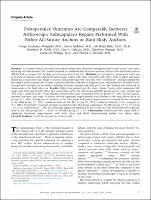
| dc.description.abstract | Purpose
To compare clinical outcomes and tendon healing rates of patients undergoing arthroscopic rotator cuff repairs involving the subscapularis (SSC) tendon (isolated or combined) with all-suture anchors (ASAs) versus hard-body anchors (HBAs) and to compare SSC healing rates between these 2 anchors.
Methods
A retrospective comparative study was performed on patients who underwent arthroscopic rotator cuff repair of the SSC with either ASAs or HBAs and had a minimum 2-year follow-up. Range of motion and patient-reported outcomes were collected pre- and postoperatively, including a visual analog scale for pain, American Shoulder and Elbow Surgeons score, and Subjective Shoulder Value. Postoperative strength was measured, including Constant strength and belly press test. SSC healing was evaluated on ultrasounds at the final follow-up.
Results
Eighty-four patients met the study criteria. Twenty-eight underwent SSC repair with ASAs and 56 with HBAs. The mean follow-up for the ASA group and HBA group was 44 ± 22.7 months and 48.4 ± 28.3, respectively (P = .743). Baseline characteristics were comparable between groups (P > .05). Overall, patient-reported outcomes and range of motion showed significant improvements from baseline to the final follow-up in all groups (P < .001). Postoperatively, patients in the ASA group had greater improvement in forward flexion compared to the HBA group: 31° (95% confidence interval, 20°-42°) versus 14° (95% confidence interval, 5°-8°), respectively (P = .002). Postoperative Constant strength was higher in the ASA group compared to the HBA group: 17.5 ± 7.5 versus 13.5 ± 5.6, respectively (P = .04). No statistically significant difference in SSC retear rates was observed between groups: none in the ASA group and 3 (10.7%) in the HBA group (P = .27).
Conclusions
Arthroscopic SSC repair leads to significant functional improvement, with both ASAs and HBAs demonstrating similar low failure rates.
Level of Evidence
Level III, retrospective cohort study. |
| dc.language.iso | eng |
| dc.publisher | Elsevier |
| dc.relation.ispartofseries | Arthroscopy, Sports Medicine, and Rehabilitation;7(2) |
| dc.rights | Attribution 4.0 International |
| dc.rights.uri | http://creativecommons.org/licenses/by/4.0/ |
| dc.source | Scientia |
| dc.subject | Avaluació de resultats (Assistència sanitària) |
| dc.subject | Sutures (Cirurgia) |
| dc.subject | Espatlles - Ferides i lesions - Cirurgia |
| dc.subject | Tendons - Ferides i lesions - Cirurgia |
| dc.subject | Artroscòpia |
| dc.subject.mesh | Suture Techniques |
| dc.subject.mesh | Treatment Outcome |
| dc.subject.mesh | Arthroscopy |
| dc.subject.mesh | Rotator Cuff Injuries |
| dc.subject.mesh | /surgery |
| dc.subject.mesh | Shoulder Injuries |
| dc.title | Postoperative Outcomes Are Comparable Between Arthroscopic Subscapularis Repairs Performed With Either All-Suture Anchors or Hard-Body Anchors |
| dc.type | info:eu-repo/semantics/article |
| dc.identifier.doi | 10.1016/j.asmr.2024.101060 |
| dc.subject.decs | resultado del tratamiento |
| dc.subject.decs | técnicas de sutura |
| dc.subject.decs | artroscopia |
| dc.subject.decs | lesiones del manguito de los rotadores |
| dc.subject.decs | /cirugía |
| dc.subject.decs | lesiones del hombro |
| dc.relation.publishversion | https://doi.org/10.1016/j.asmr.2024.101060 |
| dc.type.version | info:eu-repo/semantics/publishedVersion |
| dc.audience | Professionals |
| dc.contributor.organismes | Institut Català de la Salut |
| dc.contributor.authoraffiliation | [Gonzalez-Morgado D] Oregon Shoulder Institute, Medford, Oregon, U.S.A. Servei de Cirurgia Ortopèdica i Traumatologia, Vall d’Hebron Hospital Universitari, Barcelona, Spain. Universitat Autònoma de Barcelona, Barcelona, Spain. [Ardebol J, Noble MB, Galasso LA, Nugent M] Oregon Shoulder Institute, Medford, Oregon, U.S.A. [Kilic AI] Oregon Shoulder Institute, Medford, Oregon, U.S.A. Izmir Bakircay University, Izmir, Turkey |
| dc.identifier.pmid | 40297087 |
| dc.rights.accessrights | info:eu-repo/semantics/openAccess |

 Private area
 Contact Us