| dc.contributor | Vall d'Hebron Barcelona Hospital Campus |
| dc.contributor.author | Schab, Angela |
| dc.contributor.author | Compadre, Amanda |
| dc.contributor.author | Drexler, Rebecca |
| dc.contributor.author | loeb, Megan |
| dc.contributor.author | Rodriguez, Kevin |
| dc.contributor.author | Brill, Joshua |
| dc.contributor.author | Serra, Violeta |
| dc.date.accessioned | 2025-07-11T06:35:23Z |
| dc.date.available | 2025-07-11T06:35:23Z |
| dc.date.issued | 2025-05-20 |
| dc.identifier.citation | Schab A, Compadre A, Drexler R, Loeb M, Rodriguez K, Brill J, et al. Phospho-RPA2 predicts response to platinum and PARP inhibitors in homologous recombination-proficient ovarian cancer. J Clin Invest. 2025 May 20;135(13):e189511. |
| dc.identifier.issn | 1558-8238 |
| dc.identifier.uri | http://hdl.handle.net/11351/13394 |
| dc.description | DNA repair; Molecular diagnosis; Oncology |
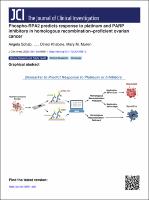
| dc.description.abstract | BACKGROUND. Treatment of tubo-ovarian high-grade serous carcinoma (HGSC) includes cytoreductive surgery, platinum-based chemotherapy, and often poly(ADP-ribose) polymerase (PARP) inhibitors. While homologous recombination (HR) deficiency is a well-established predictor of therapy sensitivity, over 50% of HR-proficient HGSCs also exhibit sensitivity. Currently, there are no biomarkers to identify which HR-proficient HGSCs will be sensitive to standard-of-care therapy. Replication stress may serve as a key determinant of response.
METHODS. We evaluated phospho–RPA2-T21 (p-RPA2) foci via immunofluorescence as a biomarker of replication stress in formalin-fixed, paraffin-embedded HGSC samples collected at diagnosis from patients treated with platinum chemotherapy (discovery cohort, n = 31; validation cohort, n = 244) or PARP inhibitors (n = 63). Recurrent HGSCs (n = 38) were also analyzed. p-RPA2 score was calculated using automated imaging analysis.
RESULTS. Samples were defined as p-RPA2-high if more than 16% of cells had ≥2 p-RPA2 foci on automated analysis. In the discovery cohort, HR-proficient, p-RPA2-high HGSCs demonstrated significantly higher rates of a chemotherapy response score of 3 to platinum chemotherapy than HR-proficient, p-RPA2-low HGSCs. In the validation cohort, patients with HR-proficient, p-RPA2-high HGSCs had significantly longer survival after platinum treatment than those with HR-proficient, p-RPA2-low HGSCs. Additionally, the p-RPA2 assay effectively predicted survival outcomes in patients treated with PARP inhibitors and in recurrent HGSC samples.
CONCLUSION. Our study underscores the importance of considering replication stress markers, such as p-RPA2, alongside HR status in therapeutic planning. This approach has the potential to increase the number of patients receiving effective therapy while reducing unnecessary toxicity. |
| dc.language.iso | eng |
| dc.publisher | American Society for Clinical Investigation |
| dc.relation.ispartofseries | The Journal of Clinical Investigation;135(13) |
| dc.rights | Attribution 4.0 International |
| dc.rights.uri | http://creativecommons.org/licenses/by/4.0/ |
| dc.source | Scientia |
| dc.subject | Platí |
| dc.subject | Recombinació genètica |
| dc.subject | Ovaris - Càncer - Tractament |
| dc.subject | Marcadors tumorals |
| dc.subject.mesh | Ovarian Neoplasms |
| dc.subject.mesh | /drug therapy |
| dc.subject.mesh | Homologous Recombination |
| dc.subject.mesh | Biomarkers, Tumor |
| dc.subject.mesh | Platinum |
| dc.title | Phospho-RPA2 predicts response to platinum and PARP inhibitors in homologous recombination–proficient ovarian cancer |
| dc.type | info:eu-repo/semantics/article |
| dc.identifier.doi | 10.1172/JCI189511 |
| dc.subject.decs | neoplasias ováricas |
| dc.subject.decs | /farmacoterapia |
| dc.subject.decs | recombinación homóloga |
| dc.subject.decs | marcadores tumorales |
| dc.subject.decs | platino (metal) |
| dc.relation.publishversion | https://doi.org/10.1172/JCI189511 |
| dc.type.version | info:eu-repo/semantics/publishedVersion |
| dc.audience | Professionals |
| dc.contributor.organismes | Institut Català de la Salut |
| dc.contributor.authoraffiliation | [Schab A, Compadre A, Drexler R, Loeb M, Rodriguez K] Division of Gynecologic Oncology, Department of Obstetrics and Gynecology, Washington University, St. Louis, Missouri, USA. Center for Reproductive Health Sciences, Department of Obstetrics and Gynecology, Mayo Clinic, Rochester, Minnesota, USA. [Brill J] Division of Gynecologic Oncology, Department of Obstetrics and Gynecology, Washington University, St. Louis, Missouri, USA. [Serra V] Experimental Therapeutics Group, Vall d’Hebron Institute of Oncology (VHIO), Barcelona, Spain |
| dc.identifier.pmid | 40392598 |
| dc.rights.accessrights | info:eu-repo/semantics/openAccess |

 Private area
 Contact Us