| dc.contributor | Vall d'Hebron Barcelona Hospital Campus |
| dc.contributor.author | Muñoz, Andres |
| dc.contributor.author | Adeva, Jorge |
| dc.contributor.author | Peinado, Paloma |
| dc.contributor.author | Aguilar, Susana |
| dc.contributor.author | Vega Cano, Kreina Sharela |
| dc.contributor.author | Macarulla, Teresa |
| dc.contributor.author | Castet, Florian |
| dc.contributor.author | Soto Alsar, Javier |
| dc.contributor.author | Graña, Begoña |
| dc.date.accessioned | 2025-08-05T10:23:01Z |
| dc.date.available | 2025-08-05T10:23:01Z |
| dc.date.issued | 2025-06 |
| dc.identifier.citation | Muñoz Martín AJ, Castet F, Soto Alsar J, Adeva J, Peinado P, Graña B, et al. MDM2 amplification in a real-world cohort of patients with biliary tract cancer from the Spanish RETUD gastrointestinal registry. ESMO Gastrointest Oncol. 2025 Jun;8:100187. |
| dc.identifier.issn | 2949-8198 |
| dc.identifier.uri | http://hdl.handle.net/11351/13485 |
| dc.description | MDM2 amplification; Biliary tract cancer; Spain |
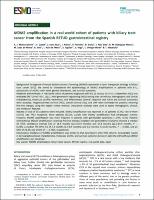
| dc.description.abstract | Background
Antagonist of mouse double minute 2 homolog (MDM2) represents a novel therapeutic strategy in biliary tract cancer (BTC). We aimed to characterize the epidemiology of MDM2 amplifications in patients with BTC, associations of MDM2 with other genetic alterations, and survival outcomes.
Materials and methods
A real-world cohort of patients diagnosed with BTC (1 January 2017 to 31 December 2022) was evaluated (RETUD NCT06711211). Next-generation sequencing (NGS) testing was carried out. Demographic and clinical characteristics, molecular profile, treatments, and effectiveness [overall response rate (ORR) and survival outcomes] were assessed. Progression-free survival (PFS), overall survival (OS), and ORR were estimated for patients receiving first-line therapy, using the Kaplan–Meier method. Descriptive analyses were used to assess demographic, clinical, and molecular features.
Results
A total of 301 patients were included. MDM2 amplification was reported in 19 patients (6.3%); two of them (10.5%) had TP53 mutations. Most patients (63.2%; 12/19) with MDM2 amplification had intrahepatic tumors. However, MDM2 amplification was more frequent in patients with gall-bladder carcinoma (12.9%; 4/31). Patients with/without MDM2 amplification receiving first-line therapy [cisplatin and gemcitabine (CisGem)] showed a median OS [95% confidence interval (CI)] of 18.4 months (12.3-19.9 months) and 17.8 months (12.3-19.9 months, P = 0.247), a median PFS (95% CI) of 5.3 months (2.7-8.9 months) and 6.0 months (5.3-6.8 months, P = 0.423), and an ORR of 21.4% and 29.6% (P = 0.762), respectively.
Conclusions
Incidence of MDM2 amplification was similar to that described in other BTC cohorts. Comparable results in demographic/clinical characteristics, molecular profile, and survival outcomes between patients with/without MDM2 amplification was observed. |
| dc.language.iso | eng |
| dc.publisher | Elsevier |
| dc.relation.ispartofseries | ESMO Gastrointestinal Oncology;8 |
| dc.rights | Attribution-NonCommercial-NoDerivatives 4.0 International |
| dc.rights.uri | http://creativecommons.org/licenses/by-nc-nd/4.0/ |
| dc.source | Scientia |
| dc.subject | Conductes biliars - Càncer - Aspectes genètics |
| dc.subject | Amplificació gènica |
| dc.subject | Seqüència de nucleòtids |
| dc.subject.mesh | Bile Duct Neoplasms |
| dc.subject.mesh | /genetics |
| dc.subject.mesh | High-Throughput Nucleotide Sequencing |
| dc.subject.mesh | Proto-Oncogene Proteins c-mdm2 |
| dc.subject.mesh | Gene Amplification |
| dc.title | MDM2 amplification in a real-world cohort of patients with biliary tract cancer from the Spanish RETUD gastrointestinal registry |
| dc.type | info:eu-repo/semantics/article |
| dc.identifier.doi | 10.1016/j.esmogo.2025.100187 |
| dc.subject.decs | neoplasias de los conductos biliares |
| dc.subject.decs | /genética |
| dc.subject.decs | secuenciación de nucleótidos de alto rendimiento |
| dc.subject.decs | proteínas protooncogénicas c-mdm2 |
| dc.subject.decs | amplificación génica |
| dc.relation.publishversion | https://doi.org/10.1016/j.esmogo.2025.100187 |
| dc.type.version | info:eu-repo/semantics/publishedVersion |
| dc.audience | Professionals |
| dc.contributor.organismes | Institut Català de la Salut |
| dc.contributor.authoraffiliation | [Muñoz Martín AJ, Soto Alsar J] Medical Oncology Department, Hospital General Universitario Gregorio Marañón, Universidad Complutense, Madrid, Spain. [Castet F, Vega S, Macarulla T] Servei d’Oncologia Mèdica, Vall d’Hebron Hospital Universitari, Barcelona, Spain. Vall d’Hebron Institute of Oncology (VHIO), Barcelona, Spain. [Adeva J] Medical Oncology Department, Hospital Universitario 12 de Octubre, Instituto de Investigación i+12, Universidad Complutense de Madrid, Madrid, Spain. [Peinado P] Department of Medical Oncology, Centro Integral Oncológico Clara Campal (HM CIOCC Madrid), Hospital Universitario HM Sanchinarro, HM Hospitales, Instituto de Investigación Sanitaria HM Hospitales, Madrid, Spain. [Graña B] Medical Oncology Department, Pontevedra University Hospital, Galicia Sur Health Research Institute (IISGS), Pontevedra, Spain. [Aguilar S] VHIOTECA & Prescreening Program, Vall d’Hebron Institute of Oncology (VHIO), Barcelona, Spain |
| dc.rights.accessrights | info:eu-repo/semantics/openAccess |

 Private area
 Contact Us