| dc.contributor | Vall d'Hebron Barcelona Hospital Campus |
| dc.contributor.author | Grossi, Elena |
| dc.contributor.author | Marchese, Francesco |
| dc.contributor.author | González, Jovanna |
| dc.contributor.author | Goñi, Enrique |
| dc.contributor.author | Fernández-Justel, José Miguel |
| dc.contributor.author | Amadoz, Alicia |
| dc.contributor.author | Herranz Martín, Nicolás |
| dc.date.accessioned | 2025-09-05T09:26:28Z |
| dc.date.available | 2025-09-05T09:26:28Z |
| dc.date.issued | 2025-06-24 |
| dc.identifier.citation | Grossi E, Marchese FP, González J, Goñi E, Fernández-Justel JM, Amadoz A, et al. A lncRNA-mediated metabolic rewiring of cell senescence. Cell Rep. 2025 Jun 24;44(6):115747. |
| dc.identifier.issn | 2211-1247 |
| dc.identifier.uri | http://hdl.handle.net/11351/13618 |
| dc.description | Metabolism; RNA-binding proteins; Senescence |
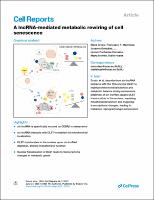
| dc.description.abstract | Despite not proliferating, senescent cells remain metabolically active to maintain the senescence program. However, the mechanisms behind this metabolic reprogramming are not well understood. We identify senescence-induced long noncoding RNA (sin-lncRNA), a previously uncharacterized long noncoding RNA (lncRNA), a key player in this response. While strongly activated in senescence by C/EBPβ, sin-lncRNA loss reinforces the senescence program by altering oxidative phosphorylation and rewiring mitochondrial metabolism. By interacting with dihydrolipoamide S-succinyltransferase (DLST), it facilitates its mitochondrial localization. Depletion of sin-lncRNA causes DLST nuclear translocation, leading to transcriptional changes in oxidative phosphorylation (OXPHOS) genes. While not expressed in highly proliferative cancer cells, it is strongly induced upon cisplatin-induced senescence. Depletion of sin-lncRNA in ovarian cancer cells reduces oxygen consumption and increases extracellular acidification, sensitizing cells to cisplatin treatment. Altogether, these results indicate that sin-lncRNA is specifically induced in senescence to maintain metabolic homeostasis, unveiling an RNA-dependent metabolic rewiring specific to senescent cells. |
| dc.language.iso | eng |
| dc.publisher | Elsevier |
| dc.relation.ispartofseries | Cell Reports;44(6) |
| dc.rights | Attribution-NonCommercial-NoDerivatives 4.0 International |
| dc.rights.uri | http://creativecommons.org/licenses/by-nc-nd/4.0/ |
| dc.source | Scientia |
| dc.subject | Metabolisme |
| dc.subject | Cèl·lules - Envelliment |
| dc.subject | RNA |
| dc.subject.mesh | RNA, Long Noncoding |
| dc.subject.mesh | Cellular Senescence |
| dc.subject.mesh | Metabolism |
| dc.title | A lncRNA-mediated metabolic rewiring of cell senescence |
| dc.type | info:eu-repo/semantics/article |
| dc.identifier.doi | 10.1016/j.celrep.2025.115747 |
| dc.subject.decs | ARN largo no codificante |
| dc.subject.decs | senescencia celular |
| dc.subject.decs | metabolismo |
| dc.relation.publishversion | https://doi.org/10.1016/j.celrep.2025.115747 |
| dc.type.version | info:eu-repo/semantics/publishedVersion |
| dc.audience | Professionals |
| dc.contributor.organismes | Institut Català de la Salut |
| dc.contributor.authoraffiliation | [Grossi E] Center for Applied Medical Research, University of Navarra, Pamplona, Spain. Institute of Health Research of Navarra (IdiSNA), Pamplona, Spain. Departments of Oncological Sciences and Dermatology, Icahn School of Medicine at Mount Sinai, New York, NY, USA. Tisch Cancer Institute, Icahn School of Medicine at Mount Sinai, New York, NY, USA. [Marchese FP, González J, Goñi E, Fernández-Justel JM, Amadoz A] Center for Applied Medical Research, University of Navarra, Pamplona, Spain. Institute of Health Research of Navarra (IdiSNA), Pamplona, Spain. [Herranz N] Vall d’Hebron Institute of Oncology (VHIO), Barcelona, Spain. Vall d’Hebron Institut de Recerca (VHIR), Barcelona, Spain |
| dc.identifier.pmid | 40408249 |
| dc.identifier.wos | 001501902100003 |
| dc.rights.accessrights | info:eu-repo/semantics/openAccess |

 Private area
 Contact Us