| dc.contributor | Vall d'Hebron Barcelona Hospital Campus |
| dc.contributor.author | Spearman, Catherine Wendy |
| dc.contributor.author | Siebelt, Karin |
| dc.contributor.author | El-Sayed, Manal |
| dc.contributor.author | Buti Ferret, Maria |
| dc.date.accessioned | 2025-10-07T09:48:17Z |
| dc.date.available | 2025-10-07T09:48:17Z |
| dc.date.issued | 2025-09 |
| dc.identifier.citation | Buti M, Spearman CW, Siebelt K, El-Sayed M. Hepatitis D epidemiology and access to diagnostic testing among healthcare providers in Africa: A multi-country survey. JHEP Reports. 2025 Sep;7(9):101495. |
| dc.identifier.issn | 2589-5559 |
| dc.identifier.uri | http://hdl.handle.net/11351/13800 |
| dc.description | Diagnosis; Epidemiology; Hepatitis D |
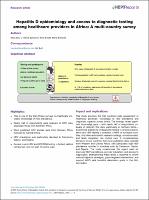
| dc.description.abstract | Background & Aims
Reliable data on the prevalence of chronic HDV infection in Africa are limited. To address this, a multi-country survey was conducted across Africa to assess healthcare providers’ knowledge of HDV prevalence and the availability of diagnostic testing. This was complemented by a literature review of regional HDV prevalence data.
Methods
A 12-item web-based questionnaire, created using Google forms, was distributed to all members of SOLDA (the Society on Liver Disease in Africa) and Project ECHO Viral Hepatitis in sub-Saharan Africa (n = 1,210) through African network channels. Survey responses were analyzed using descriptive statistics; all analyses were performed using GraphPad Prism 6.
Results
A total of 1,210 surveys were distributed and completed by 608 participants across 43/54 (80%) African countries (44% Eastern, 36% Western, 8% Southern, 6% Northern, and 6% Central regions). Participants from 24/43 (56%) countries were aware of national HDV epidemiological data, mainly in relation to HBsAg carriers (77%), blood donors (23%), patients with chronic liver disease (25%), and those with hepatocellular carcinoma (18%). Anti-HDV antibody testing was available in 30/43 (69%) countries, primarily in clinical studies. The literature review identified 49 studies from 21 countries (mainly in Western and Central Africa), revealing a particularly high HDV prevalence in some countries (Cameroon, Gabon, and Nigeria). In 16 of 22 countries, survey participants’ awareness of HDV prevalence was consistent with published data.
Conclusions
Healthcare providers’ knowledge of HDV prevalence varies across African countries, with 56% aware of national data and 73% aligned with published estimates. While diagnostic testing is available in 69% of countries, it remains limited, is seldom reimbursed, and is not routinely integrated into clinical practice.
Impact and implications
This study provides the first continent-wide assessment of healthcare providers’ knowledge of HDV prevalence and diagnostic capacity across Africa. The findings reveal significant knowledge gaps – with nearly half of respondents unaware of national HDV data, particularly in Northern Africa – and limited availability of diagnostic testing in clinical practice. While anti-HDV testing is available in 69% of surveyed countries, it is often restricted to research settings, not reimbursed, and rarely integrated into routine care. A complementary literature review confirms that most published data originate from Western and Central Africa, with particularly high HDV prevalence reported in countries such as Cameroon, Gabon, and Nigeria. The study underscores the urgent need for improved HDV surveillance, provider education, and access to diagnostics. Strengthening these areas is essential to inform national hepatitis strategies, guide targeted interventions, and support WHO viral hepatitis elimination goals in the African region. |
| dc.language.iso | eng |
| dc.publisher | Elsevier |
| dc.relation.ispartofseries | JHEP Reports;7(9) |
| dc.rights | Attribution 4.0 International |
| dc.rights.uri | http://creativecommons.org/licenses/by/4.0/ |
| dc.source | Scientia |
| dc.subject | Hepatitis - Epidemiologia |
| dc.subject | Enquestes |
| dc.subject | Hepatitis - Diagnòstic |
| dc.subject.mesh | Hepatitis D |
| dc.subject.mesh | /epidemiology |
| dc.subject.mesh | Surveys and Questionnaires |
| dc.title | Hepatitis D epidemiology and access to diagnostic testing among healthcare providers in Africa: A multi-country survey |
| dc.type | info:eu-repo/semantics/article |
| dc.identifier.doi | 10.1016/j.jhepr.2025.101495 |
| dc.subject.decs | hepatitis D |
| dc.subject.decs | /epidemiología |
| dc.subject.decs | encuestas y cuestionarios |
| dc.relation.publishversion | https://doi.org/10.1016/j.jhepr.2025.101495 |
| dc.type.version | info:eu-repo/semantics/publishedVersion |
| dc.audience | Professionals |
| dc.contributor.organismes | Institut Català de la Salut |
| dc.contributor.authoraffiliation | [Buti M] Servei d’Hepatologia, Servei de Medicina Interna, Vall d’Hebron Hospital Universitari, Barcelona, Spain. Universitat Autònoma de Barcelona, Bellaterra, Spain. Centro de Investigación Biomédica en Red de Enfermedades Hepáticas y Digestivas (CIBERehd), Instituto de Salud Carlos III, Madrid, Spain. [Spearman CW] Division of Hepatology, Department of Medicine, Faculty of Health Sciences, University of Cape Town, South Africa. [Siebelt K] Academic Medical Education, Utrecht, The Netherlands. [El-Sayed M] Ain Shams University, Cairo, Egypt |
| dc.identifier.pmid | 40823167 |
| dc.rights.accessrights | info:eu-repo/semantics/openAccess |

 Private area
 Contact Us