| dc.contributor | Vall d'Hebron Barcelona Hospital Campus |
| dc.contributor.author | Gosset, Clement |
| dc.contributor.author | Barbosa, Susana |
| dc.contributor.author | DESTERE, Alexandre |
| dc.contributor.author | Cuozzo, Sebastien |
| dc.contributor.author | Albano, Laetitia |
| dc.contributor.author | Morelon, Emmanuel |
| dc.contributor.author | Bestard, Oriol |
| dc.date.accessioned | 2025-10-07T10:32:20Z |
| dc.date.available | 2025-10-07T10:32:20Z |
| dc.date.issued | 2025-07 |
| dc.identifier.citation | Gosset C, Barbosa S, Destere A, Cuozzo S, Albano L, Morelon E, et al. Maximum cold ischemia duration for a kidney allograft: a prediction model for allograft failure at the time of organ allocation. eClinicalMedicine. 2025 Jul;85:103322. |
| dc.identifier.issn | 2589-5370 |
| dc.identifier.uri | http://hdl.handle.net/11351/13804 |
| dc.description | Allograft allocation; Cold ischemia; Predictive model |
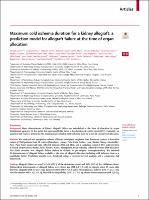
| dc.description.abstract | Background
Many determinants of kidney allograft failure are established at the time of allocation by organ distribution agencies. At this point, the main modifiable factor is the duration of cold ischemia (CIT). Currently, no practical tool exists to determine the maximum permissible cold ischemia time for a specific recipient at allocation.
Methods
We analyzed two prospective cohorts of kidney transplant recipients from European centers: a derivation cohort of 7040 patients from 10 centers (Barcelona; Leuven; Oslo; Paris Necker, Lyon, Nantes, Nancy, Montpellier, Nice, Paris Saint Louis) with data collected between 2005 and 2020, and a validation cohort of 6131 patients from 6 French centers (Paris Necker, Lyon, Nantes, Nancy, Montpellier, Nice) with data collected between 2008 and 2019. The main outcome was allograft failure (return to dialysis or pre-emptive retransplantation). We assessed 26 determinants of allograft failure available at the time of allograft allocation including cold ischemia time as a modifiable factor. Prediction models were developed using a classical survival analysis and a competing risk framework.
Findings
Allograft failure occurred in 16% (1113) of the derivation cohort and 14% (832) of the validation cohort. Independent determinants of allograft failure were donor age (HR 2.2 [1.9–2.6] for donors above 65 years old), previous allografts (HR 1.5 [1.3–1.6]), dialysis history (HR 1.7 [1.3–2] for Hemodialysis), diabetes (HR 1.4 [1.2–1.6]), vascular disease (HR 1.3 [1.1–1.5]), HLA-DR incompatibility (HR 1.2 [1.1–1.3]), donor serum creatinine (HR 1 [1–1]), and cold ischemia time (HR 1 [1–1]). Donor age was the strongest contributor, while cold ischemia was the only modifiable factor. These factors were combined into two predictive models of kidney allograft failure (Cox regression and Fine Gray) showing accurate calibration, and discrimination with a C-Index of 0.66 (95% CI: 0.63–0.70 at year one) on the validation cohort for the Fine Gray model. The Fine–Gray model, which accounts for the competing risks between allograft failure and patient death, was used to develop a practical tool for predicting allograft failure based on cold ischemia.
Interpretation
Prediction model at the time of allocation provides a simple and practical tool which may guide organ distribution agencies and medico-surgical teams by customizing cold ischemia time for a kidney allograft transplantation. |
| dc.language.iso | eng |
| dc.publisher | Elsevier |
| dc.relation.ispartofseries | eClinicalMedicine;85 |
| dc.rights | Attribution-NonCommercial-NoDerivatives 4.0 International |
| dc.rights.uri | http://creativecommons.org/licenses/by-nc-nd/4.0/ |
| dc.source | Scientia |
| dc.subject | Ronyons - Trasplantació - Complicacions |
| dc.subject | Al·loempelts |
| dc.subject | Conservació d'òrgans, teixits, etc. |
| dc.subject.mesh | Cold Ischemia |
| dc.subject.mesh | Kidney Transplantation |
| dc.subject.mesh | /adverse effects |
| dc.subject.mesh | Allografts |
| dc.subject.mesh | Tissue and Organ Procurement |
| dc.title | Maximum cold ischemia duration for a kidney allograft: a prediction model for allograft failure at the time of organ allocation |
| dc.type | info:eu-repo/semantics/article |
| dc.identifier.doi | 10.1016/j.eclinm.2025.103322 |
| dc.subject.decs | isquemia fría |
| dc.subject.decs | trasplante de riñón |
| dc.subject.decs | /efectos adversos |
| dc.subject.decs | aloinjertos |
| dc.subject.decs | obtención de tejidos y órganos |
| dc.relation.publishversion | https://doi.org/10.1016/j.eclinm.2025.103322 |
| dc.type.version | info:eu-repo/semantics/publishedVersion |
| dc.audience | Professionals |
| dc.contributor.organismes | Institut Català de la Salut |
| dc.contributor.authoraffiliation | [Gosset C] Laboratory of Molecular Physio Medicine (LP2M), UMR 7370, CNRS, University Côte d’Azur, Nice, France. Department of Nephrology-Dialysis-Transplantation, University Hospital Centre of Nice, Nice, France. [Barbosa S] Institute of Molecular and Cellular Pharmacology (IPMC), UMR 7275 CNRS, University Côte d’Azur, Nice, France. [Destere A] Department of Pharmacology, University Hospital Centre of Nice, Nice, France. [Cuozzo S, Albano L] Department of Nephrology-Dialysis-Transplantation, University Hospital Centre of Nice, Nice, France. [Morelon E] Department of Transplantation, Nephrology and Clinical Immunology, Edouard Herriot Hospital, Hospices Civils de Lyon, Lyon, France. University Claude Bernard Lyon 1, Villeurbanne, France. [Bestard O] Kidney Transplantation Nephrology department, Bellvitge University Hospital, Barcelona, Spain. Servei de Nefrologia, Vall d’Hebron Hospital Universitari, Barcelona, Spain |
| dc.identifier.pmid | 40686676 |
| dc.identifier.wos | 001529858700001 |
| dc.rights.accessrights | info:eu-repo/semantics/openAccess |

 Private area
 Contact Us