| dc.contributor | Vall d'Hebron Barcelona Hospital Campus |
| dc.contributor.author | Mall, Marcus |
| dc.contributor.author | Wainwright, Claire |
| dc.contributor.author | Legg, Julian |
| dc.contributor.author | Chilvers, Mark |
| dc.contributor.author | Dittrich, Anna-Maria |
| dc.contributor.author | Gartner, Silvia |
| dc.date.accessioned | 2025-10-16T07:26:38Z |
| dc.date.available | 2025-10-16T07:26:38Z |
| dc.date.issued | 2025 |
| dc.identifier.citation | Mall MA, Wainwright CE, Legg J, Chilvers M, Gartner S, Dittrich AM, et al. Elexacaftor/tezacaftor/ivacaftor in children aged ≥6 years with cystic fibrosis heterozygous for F508del and a minimal function mutation: Results from a 96-week open-label extension study. Eur Respir J. 2025;66(1):2402435. |
| dc.identifier.issn | 1399-3003 |
| dc.identifier.uri | http://hdl.handle.net/11351/13876 |
| dc.description | Children; Cystic fibrosis; Mutation |
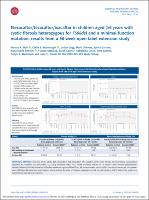
| dc.description.abstract | Background: Elexacaftor/tezacaftor/ivacaftor (ELX/TEZ/IVA) was efficacious and safe in children aged 6-11 years with cystic fibrosis (CF) heterozygous for F508del and a minimal function CF transmembrane conductance regulator (CFTR) variant (F/MF genotypes) in a 24-week, placebo-controlled trial. We conducted a 96-week open-label extension study for children who completed the 24-week parent study.
Methods: In this phase 3b extension study, dosing was based on weight and age, with children weighing <30 kg and aged <12 years receiving ELX 100 mg once daily, TEZ 50 mg once daily and IVA 75 mg every 12 h, and children ≥30 kg or ≥12 years receiving ELX 200 mg once daily, TEZ 100 mg once daily and IVA 150 mg every 12 h. The primary end-point was safety and tolerability. Secondary and other efficacy end-points included absolute changes from parent study baseline in sweat chloride concentration, lung clearance index (LCI2.5), percentage predicted forced expiratory volume in 1 s (FEV1) and Cystic Fibrosis Questionnaire-Revised (CFQ-R) respiratory domain score.
Results: A total of 120 children were enrolled and dosed. 118 children (98.3%) had adverse events (AEs), which for most were mild (43.3%) or moderate (48.3%) in severity. The most common AEs (≥20% of children) were COVID-19 (58.3%), cough (51.7%), nasopharyngitis (45.0%), pyrexia (40.0%), headache (37.5%), upper respiratory tract infection (30.8%), oropharyngeal pain (26.7%), rhinitis (24.2%), abdominal pain (22.5%) and vomiting (20.0%). Children who transitioned from the placebo and ELX/TEZ/IVA groups of the parent study had improvements from parent study baseline at Week 96 in mean sweat chloride concentration (-57.3 (95% CI -61.6- -52.9) and -57.5 (95% CI -62.0- -53.0) mmol·L-1), LCI2.5 (-1.74 (95% CI -2.09- -1.38) and -2.35 (95% CI -2.72- -1.97) units), FEV1 % pred (6.1 (95% CI 2.6-9.7) and 6.9 (95% CI 3.2-10.5) percentage points) and CFQ-R respiratory domain score (6.6 (95% CI 2.5-10.8) and 2.6 (95% CI -1.6-6.8) points).
Conclusions: ELX/TEZ/IVA treatment was generally safe and well tolerated, with a safety profile consistent with the parent study and older age groups. After starting ELX/TEZ/IVA, children had robust improvements in sweat chloride concentration and lung function that were maintained through 96 weeks. These results demonstrate the safety and durable efficacy of ELX/TEZ/IVA in this paediatric population. |
| dc.language.iso | eng |
| dc.publisher | European Respiratory Society |
| dc.relation.ispartofseries | European Respiratory Journal;66(1) |
| dc.rights | Attribution 4.0 International |
| dc.rights.uri | http://creativecommons.org/licenses/by/4.0/ |
| dc.source | Scientia |
| dc.subject | Avaluació de resultats (Assistència sanitària) |
| dc.subject | Anomalies cromosòmiques |
| dc.subject | Fibrosi quística - Tractament |
| dc.subject | Pulmons - Malalties |
| dc.subject.mesh | Treatment Outcome |
| dc.subject.mesh | Mutation |
| dc.subject.mesh | Cystic Fibrosis |
| dc.subject.mesh | Cystic Fibrosis |
| dc.subject.mesh | Drug Combinations |
| dc.title | Elexacaftor/tezacaftor/ivacaftor in children aged ≥6 years with cystic fibrosis heterozygous for F508del and a minimal function mutation: results from a 96-week open-label extension study |
| dc.type | info:eu-repo/semantics/article |
| dc.identifier.doi | 10.1183/13993003.02435-2024 |
| dc.subject.decs | resultado del tratamiento |
| dc.subject.decs | mutación |
| dc.subject.decs | fibrosis quística |
| dc.subject.decs | fibrosis quística |
| dc.subject.decs | combinaciones de fármacos |
| dc.relation.publishversion | https://doi.org/10.1183/13993003.02435-2024 |
| dc.type.version | info:eu-repo/semantics/publishedVersion |
| dc.audience | Professionals |
| dc.contributor.organismes | Institut Català de la Salut |
| dc.contributor.authoraffiliation | [Mall MA] Department of Pediatric Respiratory Medicine, Immunology and Critical Care Medicine, Charité – Universitätsmedizin Berlin, Berlin, Germany. German Center for Child and Adolescent Health (DZKJ), partner site, Berlin, Germany. German Center for Lung Research (DZL), associated partner site Berlin, Berlin, Germany. [Wainwright CE] Queensland Children’s Hospital, University of Queensland, South Brisbane, Australia. [Legg J] National Institute for Health Research, Southampton Respiratory Biomedical Research Centre, University Hospitals Southampton NHS Foundation Trust, Southampton, UK. Southampton Children’s Hospital, University Hospitals Southampton NHS Foundation Trust, Southampton, UK. [Chilvers M] British Columbia Children’s Hospital, University of British Columbia, Vancouver, BC, Canada. [Gartner S] Vall d’Hebron Hospital Universitari, Barcelona, Spain. [Dittrich AM] Department for Pediatric Pulmonology, Allergology and Neonatology, Hannover Medical School, Hannover, Germany. BREATH, German Center for Lung Research (DZL), Hannover, Germany |
| dc.identifier.pmid | 40210412 |
| dc.rights.accessrights | info:eu-repo/semantics/openAccess |

 Private area
 Contact Us