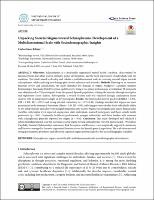
Abstract
Objectives: Schizophrenia is a profoundly stigmatized mental health condition, characterized by misconceptions that affect societal attitudes, policy development, and the lived experiences of individuals with the condition. This study aimed to develop and validate a multidimensional scale for assessing societal stigma towards schizophrenia, while exploring how demographic factors influence such attitudes. Methods: Drawing on an extensive literature review and consultations, the study identified five domains of stigma: Workplace Capability, Intimate Relationships, Autonomy, Risk Perception, and Recovery. Using a two-phase methodology, a preliminary 38-item scale was administered to 729 participants from the general Spanish population, refining the measure through descriptive and exploratory factor analysis. Subsequently, a revised 34-item scale was validated through confirmatory factor analysis with an independent sample of 417 participants. Results: The final model showed good fit (RMSEA = 0.056, CFI = 0.938, TLI = 0.933) and strong internal consistency (α = 0.73–0.86). Findings revealed that stigma was most pronounced in the domain of Autonomy (Mean = 2.83, SD = 0.91), reflecting pervasive doubts about individuals’ ability to live independently and achieve meaningful integration into society. Stigma varied significantly across demographic variables, with higher levels reported among men, older individuals, married participants, and those outside health professions (p < 0.01). Conversely, healthcare professionals, younger individuals, and those familiar with someone with schizophrenia generally reported less stigma (p < 0.01). Conclusion: This study developed and validated a robust multidimensional scale for assessing societal stigma toward schizophrenia. The five-factor model—Workplace Capability, Intimate Relationships, Autonomy, Risk Perception, and Recovery—was empirically supported. Autonomy and Recovery emerged as the most stigmatized domains across the Spanish general population. The scale demonstrated strong psychometric properties and effectively captured stigma patterns linked to key sociodemographic variables.
Keywords
Societal stigma; Schizophrenia
Bibliographic citation
Suso-Ribera C. Unpacking Societal Stigma toward Schizophrenia: Development of a Multidimensional Scale with Sociodemographic Insights. Int J Ment Health Promot. 2025 Jul 31;27(7):929–51.

 Private area
 Contact Us