| dc.contributor | Vall d'Hebron Barcelona Hospital Campus |
| dc.contributor.author | Schuler, Martin |
| dc.contributor.author | Berardi, R. |
| dc.contributor.author | Lim, Darren Wan-Teck |
| dc.contributor.author | de Jonge, M. |
| dc.contributor.author | Azaro Pedrazzoli, Analía Beatriz |
| dc.contributor.author | Bauer, Todd |
| dc.date.accessioned | 2021-10-20T08:03:21Z |
| dc.date.available | 2021-10-20T08:03:21Z |
| dc.date.issued | 2020-06 |
| dc.identifier.citation | Schuler M, Berardi R, Lim WT, de Jonge M, Bauer TM, Azaro A, et al. Molecular correlates of response to capmatinib in advanced non–small-cell lung cancer: clinical and biomarker results from a Phase I trial. Ann Oncol. 2020 Jun;31(6):789–97. |
| dc.identifier.issn | 0923-7534 |
| dc.identifier.uri | https://hdl.handle.net/11351/6421 |
| dc.description | MET mutation; Capmatinib |
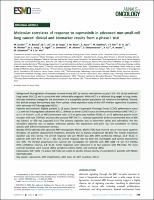
| dc.description.abstract | Background
Dysregulation of receptor tyrosine kinase MET by various mechanisms occurs in 3%–4% of non-small-cell lung cancer (NSCLC) and is associated with unfavorable prognosis. While MET is a validated drug target in lung cancer, the best biomarker strategy for the enrichment of a susceptible patient population still remains to be defined. Towards this end we analyze here primary data from a phase I dose expansion study of the MET inhibitor capmatinib in patients with advanced MET-dysregulated NSCLC.
Patients and methods
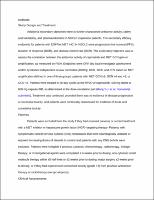
Eligible patients [≥18 years; Eastern Cooperative Oncology Group (ECOG) performance status ≤2] with MET-dysregulated advanced NSCLC, defined as either (i) MET status by immunohistochemistry (MET IHC) 2+ or 3+ or H-score ≥150, or MET/centromere ratio ≥2.0 or gene copy number (GCN) ≥5, or (ii) epidermal growth factor receptor wild-type (EGFRwt) and centrally assessed MET IHC 3+, received capmatinib at the recommended dose of 400 mg (tablets) or 600 mg (capsules) b.i.d. The primary objective was to determine safety and tolerability; the key secondary objective was to explore antitumor activity. The exploratory end point was the correlation of clinical activity with different biomarker formats.
Results
Of 55 patients with advanced MET-dysregulated NSCLC, 40/55 (73%) had received two or more prior systemic therapies. All patients discontinued treatment, primarily due to disease progression (69.1%). The median treatment duration was 10.4 weeks. The overall response rate per RECIST was 20% (95% confidence interval, 10.4–33.0). In patients with MET GCN ≥6 (n = 15), the overall response rate by both the investigator and central assessments was 47%. The median progression-free survival per investigator for patients with MET GCN ≥6 was 9.3 months (95% confidence interval, 3.8–11.9). Tumor responses were observed in all four patients with METex14. The most common toxicities were nausea (42%), peripheral edema (33%), and vomiting (31%).
Conclusions
MET GCN ≥6 and/or METex14 are suited to predict clinical activity of capmatinib in patients with NSCLC (NCT01324479). |
| dc.language.iso | eng |
| dc.publisher | Elsevier |
| dc.relation.ispartofseries | Annals of Oncology;31(6) |
| dc.rights | Attribution-NonCommercial-NoDerivatives 4.0 International |
| dc.rights.uri | http://creativecommons.org/licenses/by-nc-nd/4.0/ |
| dc.source | Scientia |
| dc.subject | Pulmons - Càncer - Aspectes genètics |
| dc.subject.mesh | Carcinoma, Non-Small-Cell Lung |
| dc.subject.mesh | Lung Neoplasms |
| dc.subject.mesh | Mutation |
| dc.title | Molecular correlates of response to capmatinib in advanced non-small-cell lung cancer: clinical and biomarker results from a phase I trial |
| dc.type | info:eu-repo/semantics/article |
| dc.identifier.doi | 10.1016/j.annonc.2020.03.293 |
| dc.subject.decs | carcinoma de pulmón de células no pequeñas |
| dc.subject.decs | neoplasias pulmonares |
| dc.subject.decs | mutación |
| dc.relation.publishversion | https://doi.org/10.1016/j.annonc.2020.03.293 |
| dc.type.version | info:eu-repo/semantics/publishedVersion |
| dc.audience | Professionals |
| dc.contributor.organismes | Institut Català de la Salut |
| dc.contributor.authoraffiliation | [Schuler M] Department of Medical Oncology, West German Cancer Center, University Duisburg-Essen, Essen, Germany. German Cancer Consortium (DKTK), Partner Site University Hospital Essen, Essen, Germany. [Berardi R] Clinica Oncologica, Università Politecnica delle Marche—Ospedali Riuniti, Ancona, Italy. [Lim WT] Division of Medical Oncology, National Cancer Centre Singapore, Singapore. [de Jonge M] Medical Oncology, Erasmus MC Cancer Center, Rotterdam, The Netherlands. [Bauer TM] Drug Development Unit, Sarah Cannon Research Institute, and Tennessee Oncology, PLCC, Nashville, USA. [Azaro A] Unitat d’Investigació de Teràpia Molecular, Servei d’Oncologia Mèdica, Vall d'Hebron Hospital Universitari, Barcelona, Spain. Departament de Farmacologia, Universitat Autònoma de Barcelona, Bellaterra, Spain |
| dc.identifier.pmid | 32240796 |
| dc.identifier.wos | 000535705600012 |
| dc.rights.accessrights | info:eu-repo/semantics/openAccess |

 Private area
 Contact Us