| dc.contributor | Vall d'Hebron Barcelona Hospital Campus |
| dc.contributor.author | Tian, Tian V |
| dc.contributor.author | Vidal, Enrique |
| dc.contributor.author | Graf, Thomas |
| dc.contributor.author | Stik, Grégoire |
| dc.date.accessioned | 2021-10-29T11:33:42Z |
| dc.date.available | 2021-10-29T11:33:42Z |
| dc.date.issued | 2020-04-29 |
| dc.identifier.citation | Tian TV, Vidal E, Graf T, Stik G. Identification of Enhancer-Promoter Contacts in Embryoid Bodies by Quantitative Chromosome Conformation Capture (4C). J Vis Exp. 2020 Apr 29;158:e60960. |
| dc.identifier.issn | 1940-087X |
| dc.identifier.uri | https://hdl.handle.net/11351/6485 |
| dc.description | Embryonic stem cells; High-throughput sequencing |
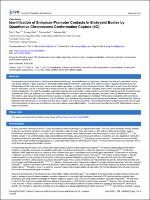
| dc.description.abstract | During mammalian development, cell fates are determined through the establishment of regulatory networks that define the specificity, timing, and spatial patterns of gene expression. Embryoid bodies (EBs) derived from pluripotent stem cells have been a popular model to study the differentiation of the main three germ layers and to define regulatory circuits during cell fate specification. Although it is well-known that tissue-specific enhancers play an important role in these networks by interacting with promoters, assigning them to their relevant target genes still remains challenging. To make this possible, quantitative approaches are needed to study enhancer-promoter contacts and their dynamics during development. Here, we adapted a 4C method to define enhancers and their contacts with cognate promoters in the EB differentiation model. The method uses frequently cutting restriction enzymes, sonication, and a nested-ligation-mediated PCR protocol compatible with commercial DNA library preparation kits. Subsequently, the 4C libraries are subjected to high-throughput sequencing and analyzed bioinformatically, allowing detection and quantification of all sequences that have contacts with a chosen promoter. The resulting sequencing data can also be used to gain information about the dynamics of enhancer-promoter contacts during differentiation. The technique described for the EB differentiation model is easy to implement. |
| dc.language.iso | eng |
| dc.publisher | MyJove Corporation |
| dc.relation.ispartofseries | Journal of Visualized Experiments;158 |
| dc.rights | Attribution-NonCommercial-NoDerivatives 3.0 International |
| dc.rights.uri | https://creativecommons.org/licenses/by-nc-nd/3.0/ |
| dc.source | Scientia |
| dc.subject | Embriologia |
| dc.subject | Seqüència de nucleòtids |
| dc.subject.mesh | Embryoid Bodies |
| dc.subject.mesh | High-Throughput Nucleotide Sequencing |
| dc.title | Identification of Enhancer-Promoter Contacts in Embryoid Bodies by Quantitative Chromosome Conformation Capture (4C) |
| dc.type | info:eu-repo/semantics/article |
| dc.identifier.doi | 10.3791/60960 |
| dc.subject.decs | cuerpos embrioides |
| dc.subject.decs | secuenciación de nucleótidos de alto rendimiento |
| dc.relation.publishversion | https://doi.org/10.3791/60960 |
| dc.type.version | info:eu-repo/semantics/publishedVersion |
| dc.audience | Professionals |
| dc.contributor.organismes | Institut Català de la Salut |
| dc.contributor.authoraffiliation | [Tian TV] Center for Genomic Regulation (CRG), The Barcelona Institute of Science and Technology, Barcelona, Spain. Universitat Pompeu Fabra, Barcelona, Spain. Vall d'Hebron Institute of Oncology (VHIO), Barcelona, Spain. [Vidal E, Graf T, Stik G] Center for Genomic Regulation (CRG), The Barcelona Institute of Science and Technology, Barcelona, Spain. Universitat Pompeu Fabra, Barcelona, Spain |
| dc.identifier.pmid | 32420995 |
| dc.identifier.wos | 000530896100039 |
| dc.relation.projectid | info:eu-repo/grantAgreement/ES/PE2013-2016/FJCI-2014-22946 |
| dc.relation.projectid | info:eu-repo/grantAgreement/EC/FP7/609989 |
| dc.rights.accessrights | info:eu-repo/semantics/openAccess |

 Private area
 Contact Us