| dc.contributor | Vall d'Hebron Barcelona Hospital Campus |
| dc.contributor.author | Santos García, Diego |
| dc.contributor.author | de Deus Fonticoba, Teresa |
| dc.contributor.author | Cores, Carlos |
| dc.contributor.author | Muñoz, Guillermo |
| dc.contributor.author | Paz González, Jose M |
| dc.contributor.author | Martínez Miró, Cristina |
| dc.contributor.author | Hernández Vara, Jorge |
| dc.contributor.author | de Fabregues-Boixar Nebot, Oriol |
| dc.date.accessioned | 2022-05-18T07:44:50Z |
| dc.date.available | 2022-05-18T07:44:50Z |
| dc.date.issued | 2021-12-16 |
| dc.identifier.citation | Santos García D, de Deus Fonticoba T, Cores C, Muñoz G, Paz González JM, Martínez Miró C, et al. Predictors of clinically significant quality of life impairment in Parkinson’s disease. NPJ Park Dis. 2021 Dec 16;7:118. |
| dc.identifier.issn | 2373-8057 |
| dc.identifier.uri | https://hdl.handle.net/11351/7542 |
| dc.description | Parkinson's disease; Quality of life |
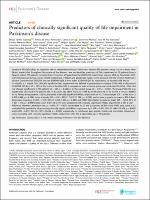
| dc.description.abstract | Quality of life (QOL) plays an important role in independent living in Parkinson’s disease (PD) patients, being crucial to know what factors impact QoL throughout the course of the disease. Here we identified predictors of QoL impairment in PD patients from a Spanish cohort. PD patients recruited from 35 centers of Spain from the COPPADIS cohort from January 2016, to November 2017, were followed up during 2 years. Health-related QoL (HRQoL) and global QoL (GQoL) were assessed with the 39-item Parkinson’s disease Questionnaire (PDQ-39) and the EUROHIS-QOL 8-item index (EUROHIS-QOL8), respectively, at baseline (V0) and at 24 months ± 1 month (V2). Clinically significant QoL impairment was defined as presenting an increase (PDQ-39SI) or decrement (EUROHIS-QOL8) at V2 ≥ 10% of the score at baseline (V0). A comparison with a control group was conducted for GQoL. GQoL did not change significantly in PD patients (N = 507; p = 0.686) or in the control group (N = 119; p = 0.192). The mean PDQ-39SI was significantly increased in PD patients (62.7 ± 8.5 years old; 58.8% males; N = 500) by 21.6% (from 16.7 ± 13 to 20.3 ± 16.4; p < 0.0001) at V2. Ninety-three patients (18.6%) presented a clinically significant HRQoL impairment at V2. To be younger (OR = 0.896; 95% CI 0.829–0.968; p = 0.006), to be a female (OR = 4.181; 95% CI 1.422–12.290; p = 0.009), and to have a greater increase in BDI-II (Beck Depression Inventory-II) (OR = 1.139; 95% CI 1.053–1.231; p = 0.001) and NMSS (Non-Motor Symptoms Scale) (OR = 1.052; 95% CI 1.027–1.113; p < 0.0001) total scores from V0 to V2 were associated with clinically significant HRQoL impairment at the 2-year follow-up (Hosmer–Lemeshow test, p = 0.665; R 2 = 0.655). An increase in ≥5 and ≥10 points of BDI-II and NMSS total score at V2 multiplied the probability of presenting clinically significant HRQoL impairment by 5 (OR = 5.453; 95% CI 1.663–17.876; p = 0.005) and 8 (OR = 8.217; 95% CI, 2.975–22.696; p = 0.002), respectively. In conclusion, age, gender, mood, and non-motor impairment were associated with clinically significant HRQoL impairment after the 2-year follow-up in PD patients. |
| dc.language.iso | eng |
| dc.publisher | Nature Research |
| dc.relation.ispartofseries | NPJ Parkinson's Disease;7 |
| dc.rights | Attribution 4.0 International |
| dc.rights.uri | http://creativecommons.org/licenses/by/4.0/ |
| dc.source | Scientia |
| dc.subject | Qualitat de vida - Avaluació |
| dc.subject | Parkinson, Malaltia de - Prognosi |
| dc.subject.mesh | Quality of Life |
| dc.subject.mesh | Parkinson Disease |
| dc.subject.mesh | Clinical Deterioration |
| dc.title | Predictors of clinically significant quality of life impairment in Parkinson’s disease |
| dc.type | info:eu-repo/semantics/article |
| dc.identifier.doi | 10.1038/s41531-021-00256-w |
| dc.subject.decs | calidad de vida |
| dc.subject.decs | enfermedad de Parkinson |
| dc.subject.decs | deterioro clínico |
| dc.relation.publishversion | https://doi.org/10.1038/s41531-021-00256-w |
| dc.type.version | info:eu-repo/semantics/publishedVersion |
| dc.audience | Professionals |
| dc.contributor.organismes | Institut Català de la Salut |
| dc.contributor.authoraffiliation | [Santos García D, Cores C, Muñoz G, Paz González JM, Martínez Miró C] CHUAC, Complejo Hospitalario Universitario de A Coruña, A Coruña, Spain. [de Deus Fonticoba T] CHUF, Complejo Hospitalario Universitario de Ferrol, A Coruña, Spain. [Hernández Vara J, de Fábregues O] Vall d’Hebron Hospital Universitari, Barcelona, Spain |
| dc.identifier.pmid | 34916528 |
| dc.identifier.wos | 000730934900001 |
| dc.rights.accessrights | info:eu-repo/semantics/openAccess |

 Private area
 Contact Us