| dc.contributor | Vall d'Hebron Barcelona Hospital Campus |
| dc.contributor.author | Garcia Rodriguez, Nicolas |
| dc.contributor.author | Rodriguez Gonzalez, Susana |
| dc.contributor.author | Ignacio Tejada, Pedro |
| dc.contributor.author | Miranda-Artieda, Zuberoa Maite |
| dc.contributor.author | Ridao, Natalia |
| dc.contributor.author | Buxo Masip, Xavier |
| dc.contributor.author | Perez-Mesquida, Maria Engracia |
| dc.contributor.author | Perez Bazan, Laura Mónica |
| dc.contributor.author | Quintana Luque, Manuel |
| dc.contributor.author | Olive Gadea, Marta |
| dc.contributor.author | Penalba Morenilla, Anna |
| dc.contributor.author | Rosell Novel, Anna |
| dc.contributor.author | Inzitari, Marco |
| dc.date.accessioned | 2022-05-30T13:30:25Z |
| dc.date.available | 2022-05-30T13:30:25Z |
| dc.date.issued | 2021-11 |
| dc.identifier.citation | Garcia-Rodriguez N, Rodriguez S, Tejada PI, Miranda-Artieda ZM, Ridao N, Buxó X, et al. Functional Recovery and Serum Angiogenin Changes According to Intensity of Rehabilitation Therapy After Stroke. Front Neurol. 2021 Nov;12:767484. |
| dc.identifier.issn | 1664-2295 |
| dc.identifier.uri | https://hdl.handle.net/11351/7586 |
| dc.description | Angiogenin; Intensive therapy; Rehabilitation |
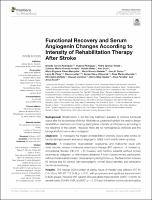
| dc.description.abstract | Background: Rehabilitation is still the only treatment available to improve functional status after the acute phase of stroke. Most clinical guidelines highlight the need to design rehabilitation treatments considering starting time, intensity, and frequency, according to the tolerance of the patient. However, there are no homogeneous protocols and the biological effects are under investigation.
Objective: To investigate the impact of rehabilitation intensity (hours) after stroke on functional improvement and serum angiogenin (ANG) in a 6-month follow-up study.
Methods: A prospective, observational, longitudinal, and multicenter study with three cohorts: strokes in intensive rehabilitation therapy (IRT, minimum 15 h/week) vs. conventional therapy (NO-IRT, <15 h/week), and controls subjects (without known neurological, malignant, or inflammatory diseases). A total of seven centers participated, with functional evaluations and blood sampling during follow-up. The final cohort includes 62 strokes and 43 controls with demographic, clinical, blood samples, and exhaustive functional monitoring.
Results: The median (IQR) number of weekly hours of therapy was different: IRT 15 (15–16) vs. NO-IRT 7.5 (5–9), p < 0.01, with progressive and significant improvements in both groups. However, IRT patients showed earlier improvements (within 1 month) on several scales (CAHAI, FMA, and FAC; p < 0.001) and the earliest community ambulation achievements (0.89 m/s at 3 months). There was a significant difference in ANG temporal profile between the IRT and NO-IRT groups (p < 0.01). Additionally, ANG was elevated at 1 month only in the IRT group (p < 0.05) whereas it decreased in the NO-IRT group (p < 0.05).
Conclusions: Our results suggest an association of rehabilitation intensity with early functional improvements, and connect the rehabilitation process with blood biomarkers. |
| dc.language.iso | eng |
| dc.publisher | Frontiers Media |
| dc.relation.ispartofseries | Frontiers in Neurology;12 |
| dc.rights | Attribution 4.0 International |
| dc.rights.uri | http://creativecommons.org/licenses/by/4.0/ |
| dc.source | Scientia |
| dc.subject | Malalties cerebrovasculars - Pacients - Rehabilitació |
| dc.subject | Avaluació de resultats (Assistència sanitària) |
| dc.subject.mesh | Stroke |
| dc.subject.mesh | /therapy |
| dc.subject.mesh | Stroke Rehabilitation |
| dc.subject.mesh | Treatment Outcome |
| dc.title | Functional Recovery and Serum Angiogenin Changes According to Intensity of Rehabilitation Therapy After Stroke |
| dc.type | info:eu-repo/semantics/article |
| dc.identifier.doi | 10.3389/fneur.2021.767484 |
| dc.subject.decs | accidente cerebrovascular |
| dc.subject.decs | /terapia |
| dc.subject.decs | rehabilitación del ictus |
| dc.subject.decs | resultado del tratamiento |
| dc.relation.publishversion | https://doi.org/10.3389/fneur.2021.767484 |
| dc.type.version | info:eu-repo/semantics/publishedVersion |
| dc.audience | Professionals |
| dc.contributor.organismes | Institut Català de la Salut |
| dc.contributor.authoraffiliation | [Garcia-Rodriguez N] Laboratori de Recerca Neurovascular, Vall d'Hebron Institut de Recerca (VHIR), Barcelona, Spain. Universitat Autònoma de Barcelona, Bellaterra, Spain. [Rodriguez S, Buxó X, Pérez-Mesquida ME] Unitat de Rehabilitació Neurològica i Dany Cerebral, Vall d'Hebron Hospital Universitari, Barcelona, Spain. [Tejada PI, Miranda-Artieda ZM] Unidad de Daño Cerebral del Hospital de Górliz, Osakidetza, Górliz, Spain. [Ridao N] Servei de Medicina Física i Rehabilitació, Parc Taulí Hospital Universitari, Institut d'Investigació i Innovació Parc Taulí I3PT, Sabadell, Spain. [Pérez LM] Grup de Recerca en Envelliment, Fragilitat i Transicions a Barcelona (REFiT), Vall d'Hebron Institut de Recerca (VHIR), Barcelona, Spain. Parc Sanitari Pere Virgili, Barcelona, Spain. Parc Sanitari Pere Virgili, Area of Intermediate Care, Barcelona, Spain. [Inzitari M] Grup de Recerca en Envelliment, Fragilitat i Transicions a Barcelona (REFiT), Vall d'Hebron Institut de Recerca (VHIR), Barcelona, Spain. Parc Sanitari Pere Virgili, Barcelona, Spain. Universitat Oberta de Catalunya, Barcelona, Spain. [Quintana M] Grup de Recerca en Epilèpsia, Vall d’Hebron Institut de Recerca (VHIR), Barcelona, Spain. Unitat d’Epilèpsia, Vall d'Hebron Hospital Universitari, Barcelona, Spain. [Olivé-Gadea M] Grup de Recerca en Ictus, Vall d'Hebron Institut de Recerca (VHIR), Barcelona, Spain. [Penalba A, Rosell A] Laboratori de Recerca Neurovascular, Vall d'Hebron Institut de Recerca (VHIR), Barcelona, Spain. Universitat Autònoma de Barcelona, Bellaterra, Spain |
| dc.identifier.pmid | 34899582 |
| dc.identifier.wos | 000728963200001 |
| dc.relation.projectid | info:eu-repo/grantAgreement/ES/PE2013-2016/PI16%2F00981 |
| dc.relation.projectid | info:eu-repo/grantAgreement/ES/PE2017-2020/PI19%2F00186 |
| dc.relation.projectid | info:eu-repo/grantAgreement/ES/PE2013-2016/RD16%2F0019%2F0021 |
| dc.rights.accessrights | info:eu-repo/semantics/openAccess |

 Private area
 Contact Us