| dc.contributor | Vall d'Hebron Barcelona Hospital Campus |
| dc.contributor.author | Sperber, Ami |
| dc.contributor.author | Bangdiwala, Shrikant |
| dc.contributor.author | Drossman, Douglas |
| dc.contributor.author | Ghoshal, Uday C |
| dc.contributor.author | Simrén, Magnus |
| dc.contributor.author | Santos Vicente, Fco Javier |
| dc.contributor.author | Tack, Jan |
| dc.date.accessioned | 2022-06-09T07:32:05Z |
| dc.date.available | 2022-06-09T07:32:05Z |
| dc.date.issued | 2021-01 |
| dc.identifier.citation | Sperber AD, Bangdiwala SI, Drossman DA, Ghoshal UC, Simren M, Tack J, et al. Worldwide Prevalence and Burden of Functional Gastrointestinal Disorders, Results of Rome Foundation Global Study. Gastroenterology. 2021 Jan;160(1):99-114.e3. |
| dc.identifier.issn | 0016-5085 |
| dc.identifier.uri | https://hdl.handle.net/11351/7651 |
| dc.description | DGBI; IBS; Epidemiology |
| dc.description.abstract | Background & Aims
Although functional gastrointestinal disorders (FGIDs), now called disorders of gut-brain interaction, have major economic effects on health care systems and adversely affect quality of life, little is known about their global prevalence and distribution. We investigated the prevalence of and factors associated with 22 FGIDs, in 33 countries on 6 continents.
Methods
Data were collected via the Internet in 24 countries, personal interviews in 7 countries, and both in 2 countries, using the Rome IV diagnostic questionnaire, Rome III irritable bowel syndrome questions, and 80 items to identify variables associated with FGIDs. Data collection methods differed for Internet and household groups, so data analyses were conducted and reported separately.
Results
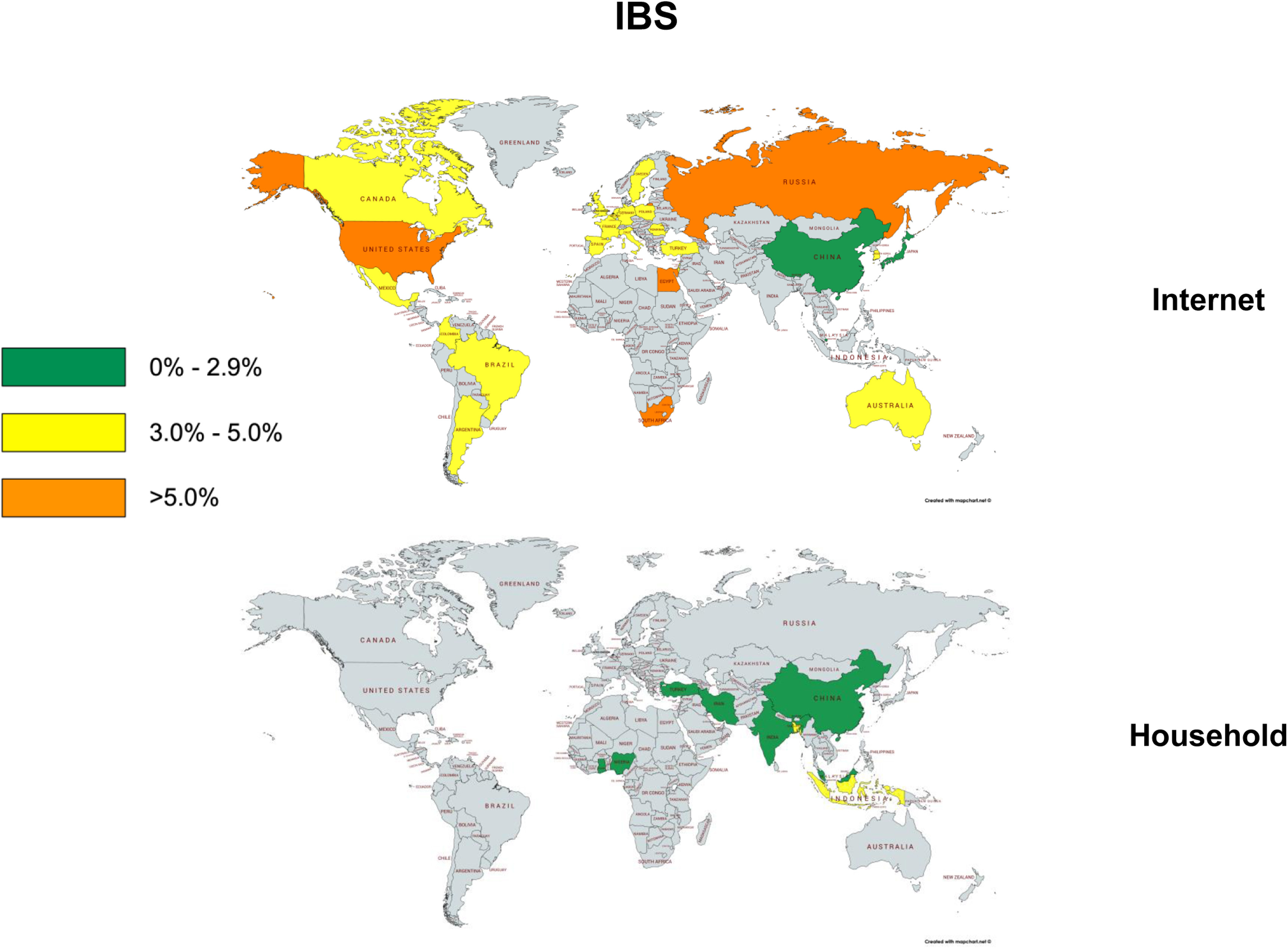
Among the 73,076 adult respondents (49.5% women), diagnostic criteria were met for at least 1 FGID by 40.3% persons who completed the Internet surveys (95% confidence interval [CI], 39.9–40.7) and 20.7% of persons who completed the household surveys (95% CI, 20.2–21.3). FGIDs were more prevalent among women than men, based on responses to the Internet survey (odds ratio, 1.7; 95% CI, 1.6–1.7) and household survey (odds ratio, 1.3; 95% CI, 1.3–1.4). FGIDs were associated with lower quality of life and more frequent doctor visits. Proportions of subjects with irritable bowel syndrome were lower when the Rome IV criteria were used, compared with the Rome III criteria, in the Internet survey (4.1% vs 10.1%) and household survey (1.5% vs 3.5%).
Conclusions
In a large-scale multinational study, we found that more than 40% of persons worldwide have FGIDs, which affect quality of life and health care use. Although the absolute prevalence was higher among Internet respondents, similar trends and relative distributions were found in people who completed Internet vs personal interviews. |
| dc.language.iso | eng |
| dc.publisher | Elsevier |
| dc.relation.ispartofseries | Gastroenterology;160(1) |
| dc.rights | Attribution-NonCommercial-NoDerivatives 4.0 International |
| dc.rights.uri | http://creativecommons.org/licenses/by-nc-nd/4.0/ |
| dc.source | Scientia |
| dc.subject | Tracte gastrointestinal - Malalties - Epidemiologia |
| dc.subject | Salut mundial |
| dc.subject | Enquestes |
| dc.subject.mesh | Gastrointestinal Diseases |
| dc.subject.mesh | /epidemiology |
| dc.subject.mesh | Global Health |
| dc.subject.mesh | Prevalence |
| dc.title | Worldwide Prevalence and Burden of Functional Gastrointestinal Disorders, Results of Rome Foundation Global Study |
| dc.type | info:eu-repo/semantics/article |
| dc.identifier.doi | 10.1053/j.gastro.2020.04.014 |
| dc.subject.decs | enfermedades gastrointestinales |
| dc.subject.decs | /epidemiología |
| dc.subject.decs | salud global |
| dc.subject.decs | prevalencia |
| dc.relation.publishversion | https://doi.org/10.1053/j.gastro.2020.04.014 |
| dc.type.version | info:eu-repo/semantics/publishedVersion |
| dc.audience | Professionals |
| dc.contributor.organismes | Institut Català de la Salut |
| dc.contributor.authoraffiliation | [Sperber AD] Faculty of Health Sciences, Ben-Gurion University of the Negev, Beer-Sheva, Israel. [Bangdiwala SI] Department of Health Research Methods, Evidence and Impact, McMaster University, Hamilton, Ontario, Canada. Population Health Research Institute, McMaster University, Hamilton, Ontario, Canada. [Drossman DA] Center for Functional GI & Motility Disorders, University of North Carolina, Center for Education and Practice of Biopsychosocial Care, and Drossman Gastroenterology, Chapel Hill, North Carolina. [Ghoshal UC] Department of Gastroenterology, Sanjay Gandhi Postgraduate Institute of Medical Sciences (SGPGI), Lucknow, India. [Simren M] Department of Internal Medicine and Clinical Nutrition, Institute of Medicine, Sahlgrenska Academy, University of Gothenburg, Gothenburg, Sweden. [Tack J] Translational Research Center for Gastrointestinal Disorders (TARGID), University of Leuven, Leuven, Belgium. [Santos J] Servei d’Aparell Digestiu, Vall d’Hebron Hospital Universitari, Barcelona, Spain. Universitat Autònoma de Barcelona, Bellaterra, Spain. Laboratori de Neuro-Inmuno-Gastroenterologia, Vall d’Hebron Institut de Recerca (VHIR), Barcelona, Spain |
| dc.identifier.pmid | 32294476 |
| dc.identifier.wos | 000600644700026 |
| dc.rights.accessrights | info:eu-repo/semantics/openAccess |

 Private area
 Contact Us