| dc.contributor | Vall d'Hebron Barcelona Hospital Campus |
| dc.contributor.author | Collins, Sean |
| dc.contributor.author | Shotwell, Matthew S. |
| dc.contributor.author | Strich, Jeffrey |
| dc.contributor.author | Gibbs, Kevin |
| dc.contributor.author | de Wit, Marjolein |
| dc.contributor.author | Files, Daniel Clark |
| dc.contributor.author | Burgos, Joaquin |
| dc.date.accessioned | 2025-01-20T11:10:17Z |
| dc.date.available | 2025-01-20T11:10:17Z |
| dc.date.issued | 2024-12 |
| dc.identifier.citation | Collins SP, Shotwell MS, Strich JR, Gibbs KW, de Wit M, Files DC, et al. Fostamatinib for Hospitalized Adults With COVID-19 and Hypoxemia: A Randomized Clinical Trial. JAMA Netw Open. 2024 Dec;7(12):e2448215–e2448215. |
| dc.identifier.issn | 2574-3805 |
| dc.identifier.uri | https://hdl.handle.net/11351/12441 |
| dc.description | Fostamatinib; COVID-19; Hypoxemia |
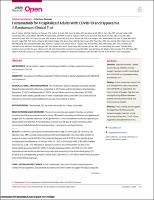
| dc.description.abstract | Importance Fostamatinib, a spleen tyrosine kinase inhibitor, has been reported to improve outcomes of COVID-19.
Objective To evaluate the efficacy and safety of fostamatinib in adults hospitalized with COVID-19 and hypoxemia.
Design, Setting, and Participants This multicenter, phase 3, placebo-controlled, double-blinded randomized clinical trial was conducted at 41 US sites and 21 international sites between November 17, 2021, and September 27, 2023; the last follow-up visit was December 31, 2023. Participants were adults aged 18 years or older hospitalized with acute SARS-CoV-2 infection and hypoxemia. Data were analyzed between January 10 and March 8, 2024.
Interventions Fostamatinib, 150 mg orally twice daily for 14 days, or placebo.
Main Outcomes and Measures The primary outcome was oxygen-free days, an ordinal outcome classifying a participant’s status at day 28 based on mortality and duration of supplemental oxygen use. An adjusted odds ratio (AOR) greater than 1.0 was considered to indicate superiority of fostamatinib over placebo. A key secondary outcome was 28-day all-cause mortality. Safety outcomes included elevated transaminase values, neutropenia, and hypertension.
Results Of the 400 participants randomized (median age, 67 years [IQR, 58-76 years]; 210 [52.5%] men), 199 received fostamatinib and 201 received placebo. The mean (SD) number of oxygen-free days was 13.4 (12.4) in the fostamatinib group and 14.2 (12.1) in the placebo group (unadjusted mean difference, −1.26 days [95% CI, −3.52 to 1.00 days]; AOR, 0.82 [95% credible interval (CrI), 0.58-1.17]). Mortality at 28 days occurred in 22 of 195 patients (11.3%) in the fostamatinib group and 16 of 197 (8.1%) in the placebo group (AOR, 1.44; 95% CrI, 0.72-2.90). Aspartate aminotransferase elevation occurred more commonly in the fostamatinib group (23 [11.6%]) than in the placebo group (11 [5.5%]; AOR, 2.28; 95% CrI, 1.07-4.84). Other safety outcomes were similar between groups.
Conclusions and Relevance In this randomized clinical trial of adults hospitalized with COVID-19 and hypoxemia, fostamatinib did not increase the number of oxygen-free days compared with placebo. These results do not support the hypothesis that fostamatinib improves outcomes among adults hospitalized with hypoxemia during the Omicron era.
Trial Registration ClinicalTrials.gov Identifier: NCT04924660 |
| dc.language.iso | eng |
| dc.publisher | American Medical Association |
| dc.relation.ispartofseries | JAMA Network Open;7(12) |
| dc.rights | Attribution 4.0 International |
| dc.rights.uri | http://creativecommons.org/licenses/by/4.0/ |
| dc.source | Scientia |
| dc.subject | COVID-19 (Malaltia) - Tractament |
| dc.subject | Anoxèmia |
| dc.subject | Avaluació de resultats (Assistència sanitària) |
| dc.subject | Proteïnes quinases - Inhibidors - Ús terapèutic |
| dc.subject.mesh | Coronavirus Infections |
| dc.subject.mesh | /drug therapy |
| dc.subject.mesh | Hypoxia |
| dc.subject.mesh | Protein Kinase Inhibitors |
| dc.subject.mesh | /therapeutic use |
| dc.subject.mesh | Treatment Outcome |
| dc.title | Fostamatinib for Hospitalized Adults With COVID-19 and Hypoxemia: A Randomized Clinical Trial |
| dc.type | info:eu-repo/semantics/article |
| dc.identifier.doi | 10.1001/jamanetworkopen.2024.48215 |
| dc.subject.decs | infecciones por Coronavirus |
| dc.subject.decs | /farmacoterapia |
| dc.subject.decs | hipoxia |
| dc.subject.decs | inhibidores de proteínas cinasas |
| dc.subject.decs | /uso terapéutico |
| dc.subject.decs | resultado del tratamiento |
| dc.relation.publishversion | https://doi.org/10.1001/jamanetworkopen.2024.48215 |
| dc.type.version | info:eu-repo/semantics/publishedVersion |
| dc.audience | Professionals |
| dc.contributor.organismes | Institut Català de la Salut |
| dc.contributor.authoraffiliation | [Collins SP] Department of Emergency Medicine, Vanderbilt University Medical Center, Nashville, Tennessee. Veterans Affairs Tennessee Valley Healthcare System, Geriatric Research, Education and Clinical Center, Nashville, Tennessee. [Shotwell MS] Department of Biostatistics, Vanderbilt University Medical Center, Nashville, Tennessee. [Strich JR] Critical Care Medicine Branch, National Heart, Lung, and Blood Institute, Bethesda, Maryland. [Gibbs KW, Files DC] Department of Medicine, Wake Forest University, Winston-Salem, North Carolina. [de Wit M] Department of Medicine, Virginia Commonwealth University, Richmond. [Burgos J] Servei de Malalties Infeccioses, Vall d’Hebron Hospital Universitari, Barcelona, Spain |
| dc.identifier.pmid | 39625722 |
| dc.identifier.wos | 001373803800007 |
| dc.rights.accessrights | info:eu-repo/semantics/openAccess |

 Private area
 Contact Us