Homologous recombination repair status in metastatic prostate cancer by next-generation sequencing and functional immunofluorescence
Author
Date
2025-02-18Permanent link
http://hdl.handle.net/11351/12845DOI
10.1016/j.xcrm.2025.101937
ISSN
2666-3791
WOS
001433264900001
PMID
39914385
Abstract
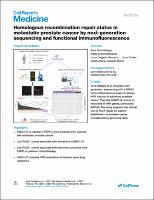
Metastatic prostate cancer (mPC) is enriched for homologous recombination repair (HRR) gene alterations, which have prognostic and predictive value. Routine clinical implementation of next-generation sequencing (NGS) is still limited. We investigated the association between genomic and functional loss of HRR, using NGS and RAD51 immunofluorescence (RAD51-IF) in 219 primary or metastatic biopsies from 187 patients with stage IV prostate cancer. NGS showed frequent genomic alterations in TP53 (40%), AR (15%), PTEN (14%), FOXA1 (12%), MYC (10%), BRCA2 (9%), ATM (8%), and BRCA1 (2%). We pursued RAD51-IF in 206 samples; of those, 139/206 (67%) were evaluable. 21% of samples had RAD51-low score compatible with HRR deficiency (HRD). RAD51-IF showed high sensitivity (71%) and specificity (86%) for BRCA1/2 alterations. Patients with RAD51-low scores experienced longer progression-free survival (PFS) on poly(ADP-ribose) polymerase inhibitors (PARPi) or platinum chemotherapy. RAD51-IF is feasible in routine clinical samples from patients with mPC and is associated with clinically relevant HRR gene alterations.
Keywords
Genomics; Immunofluorescence; Prostate cancerBibliographic citation
Arce-Gallego S, Cresta Morgado P, Delgado-Serrano L, Simonetti S, Gonzalez M, Romero-Lozano P, et al. Homologous recombination repair status in metastatic prostate cancer by next-generation sequencing and functional immunofluorescence. Cell Reports Med. 2025 Feb 18;6(2):101937.
Audience
Professionals
This item appears in following collections
- HVH - Articles científics [4470]
- VHIO - Articles científics [1250]
The following license files are associated with this item:





