| dc.contributor | Vall d'Hebron Barcelona Hospital Campus |
| dc.contributor.author | Martínez-Puchol, Sandra |
| dc.contributor.author | Itarte, Marta |
| dc.contributor.author | Rusiñol, Marta |
| dc.contributor.author | Forés, Eva |
| dc.contributor.author | Mejías-Molina, Cristina |
| dc.contributor.author | Quer Sivila, Josep |
| dc.contributor.author | Antón Pagarolas, Andrés |
| dc.contributor.author | Andrés Vergés, Cristina |
| dc.date.accessioned | 2022-07-18T10:48:47Z |
| dc.date.available | 2022-07-18T10:48:47Z |
| dc.date.issued | 2021-12-15 |
| dc.identifier.citation | Martínez-Puchol S, Itarte M, Rusiñol M, Forés E, Mejías-Molina C, Andrés C, et al. Exploring the diversity of coronavirus in sewage during COVID-19 pandemic: Don’t miss the forest for the trees. Sci Total Environ. 2021 Dec 15;800:149562. |
| dc.identifier.issn | 0048-9697 |
| dc.identifier.uri | https://hdl.handle.net/11351/7786 |
| dc.description | Coronavirus; Next generation sequencing; Sewage virome |
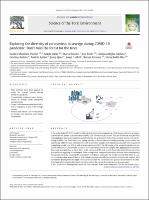
| dc.description.abstract | In the wake of the COVID-19 pandemic, the use of next generation sequencing (NGS) has proved to be an important tool for the genetic characterization of SARS-CoV-2 from clinical samples. The use of different available NGS tools applied to wastewater samples could be the key for an in-depth study of the excreted virome, not only focusing on SARS-CoV-2 circulation and typing, but also to detect other potentially pandemic viruses within the same family. With this aim, 24-hours composite wastewater samples from March and July 2020 were sequenced by applying specific viral NGS as well as target enrichment NGS. The full virome of the analyzed samples was obtained, with human Coronaviridae members (CoV) present in one of those samples after applying the enrichment. One contig was identified as HCoV-OC43 and 8 contigs as SARS-CoV-2. CoVs from other animal hosts were also detected when applying this technique. These contigs were compared with those obtained from contemporary clinical specimens by applying the same target enrichment approach. The results showed that there is a co-circulation in urban areas of human and animal coronaviruses infecting domestic animals and rodents. NGS enrichment-based protocols might be crucial to describe the occurrence and genetic characteristics of SARS-CoV-2 and other Coronaviridae family members within the excreted virome present in wastewater. |
| dc.language.iso | eng |
| dc.publisher | Elsevier |
| dc.relation.ispartofseries | Science of The Total Environment;800 |
| dc.rights | Attribution-NonCommercial-NoDerivatives 4.0 International |
| dc.rights.uri | http://creativecommons.org/licenses/by-nc-nd/4.0/ |
| dc.source | Scientia |
| dc.subject | Seqüència de nucleòtids |
| dc.subject | Aigües residuals - Anàlisi |
| dc.subject | COVID-19 (Malaltia) |
| dc.subject.mesh | Coronavirus Infections |
| dc.title | Exploring the diversity of coronavirus in sewage during COVID-19 pandemic: Don't miss the forest for the trees |
| dc.type | info:eu-repo/semantics/article |
| dc.identifier.doi | 10.1016/j.scitotenv.2021.149562 |
| dc.subject.decs | infecciones por Coronavirus |
| dc.relation.publishversion | https://doi.org/10.1016/j.scitotenv.2021.149562 |
| dc.type.version | info:eu-repo/semantics/publishedVersion |
| dc.audience | Professionals |
| dc.contributor.organismes | Institut Català de la Salut |
| dc.contributor.authoraffiliation | [Martínez-Puchol S, Itarte M, Forés E] Laboratory of Viruses Contaminants of Water and Food, Genetics, Microbiology & Statistics Dept., Universitat de Barcelona, Barcelona, Spain. The Water Research Institute (IdRA), Universitat de Barcelona, Barcelona, Spain. [Rusiñol M] Institute of Environmental Assessment & Water Research (IDAEA), CSIC, Barcelona, Spain. [Mejías-Molina C] Laboratory of Viruses Contaminants of Water and Food, Genetics, Microbiology & Statistics Dept., Universitat de Barcelona, Barcelona, Spain. [Andrés C, Antón A] Unitat de Virus Respiratoris, Secció de Virologia, Servei de Microbiologia, Vall d'Hebron Hospital Universitari, Barcelona, Spain. Vall d'Hebron Institut de Recerca (VHIR), Barcelona, Spain. Universitat Autònoma de Barcelona, Bellaterra, Spain. [Quer J] Grup de Recerca en Malalties Digestives i Hepàtiques, Vall d'Hebron Institut de Recerca (VHIR), Barcelona, Spain. Unitat del Fetge, Vall d'Hebron Hospital Universitari, Barcelona, Spain |
| dc.identifier.pmid | 34391155 |
| dc.identifier.wos | 000702859900008 |
| dc.rights.accessrights | info:eu-repo/semantics/openAccess |

 Private area
 Contact Us